What Is Shoulder Instability?
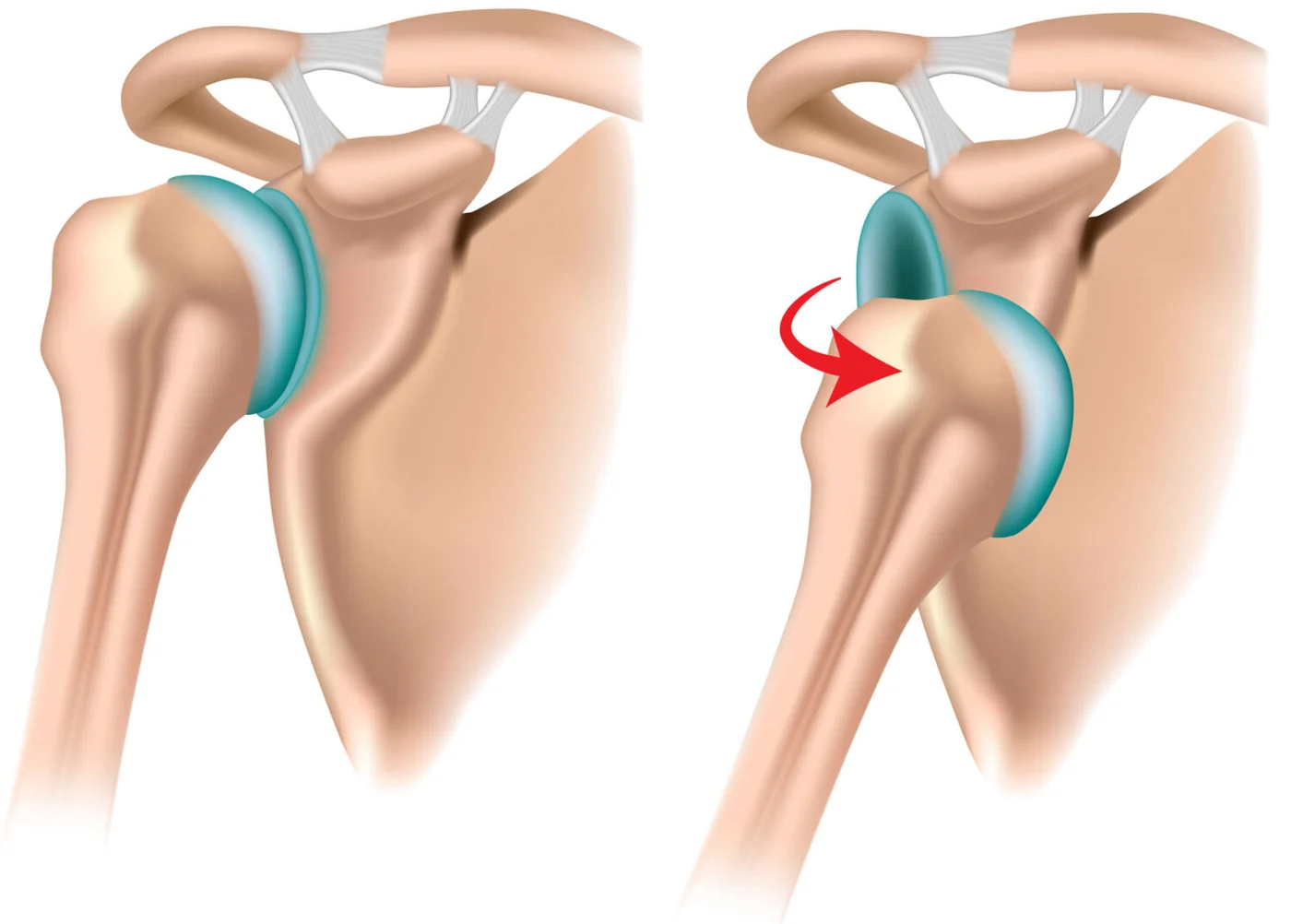
The shoulder is a ball-and-socket joint, but the socket is shallow. Much like a golf ball resting on a tee. That shape gives the shoulder its remarkable range of motion, but it also means the joint depends on soft tissue to stay stable. A rim of tissue called the labrum deepens the socket, ligaments hold the joint together, and the rotator cuff muscles squeeze the ball into place.
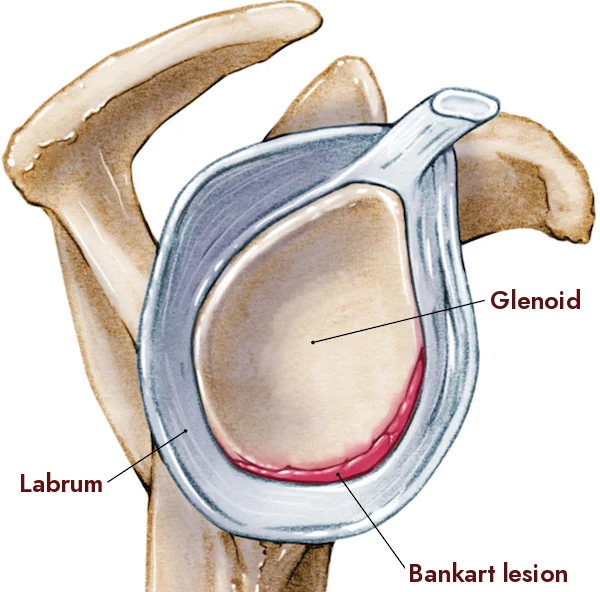
When the shoulder dislocates out the front, the labrum and the ligaments attached to it are usually torn off the front of the socket. This is called a Bankart lesion. Once those structures are damaged, the shoulder can become prone to dislocating again with less and less force. Repeated episodes can also wear away bone from the socket (glenoid bone loss) and create a dent in the ball (Hill-Sachs lesion), which makes the joint progressively less stable.
How Shoulder Instability Develops
Most instability begins with a traumatic dislocation, often in sport or from a fall, with the arm out to the side and rotated back. The majority of dislocations are anterior, meaning the ball comes out the front of the socket. Less commonly the shoulder dislocates posteriorly, classically after a seizure or electric shock, though most posterior dislocations follow an injury. Some people are simply born with looser ligaments, which allows the shoulder to slip in more than one direction without a clear injury (multidirectional instability). Putting a dislocated shoulder back in place is called a reduction, and is often done in an emergency department with sedation.
Age at the first dislocation is one of the strongest predictors of what happens next. Younger patients, particularly adolescents and those returning to contact or collision sport, have a considerably higher chance of dislocating again. Older patients (>40 y/o) who dislocate for the first time are less likely to have recurrent instability, but more likely to have an associated rotator cuff tear.
Common Symptoms
- A dislocation requiring someone to put the shoulder back in place, or one that reduces on its own
- A feeling that the shoulder is slipping or about to come out, especially with the arm overhead and rotated back
- Apprehension or guarding during certain activities or positions
- Repeated episodes that occur with progressively less force
- Pain, weakness, or numbness that may follow an episode
How It Is Diagnosed
- A detailed history of each episode, including how many, how they occurred, and how they were reduced
- Physical examination, including tests for apprehension and for the direction of instability
- X-rays to assess the joint and look for fractures or bone changes
- MRI to evaluate the bony anatomy, labrum, ligaments, and rotator cuff
- CT scan or 3D MRI, which show bone loss from the socket and the ball most accurately
Patterns of Shoulder Instability
A single traumatic dislocation, most often out the front of the socket.
Depends heavily on age, sport, and bone loss to prevent recurrence
Repeated dislocations or a shoulder that slips out with progressively less force.
Surgical stabilization is usually recommended
The ball slides partly out of the socket and returns on its own, often with a feeling of slipping.
Evaluated similarly to full dislocation
Enough bone has worn from the socket or the ball that soft tissue repair alone is unlikely to prevent recurrence
A bone grafting procedure is generally needed
The shoulder is loose in more than one direction, often without a clear injury. Often in ligamentously lax patients.
Physical therapy is the mainstay of treatment
Why Bone Loss Changes the Plan
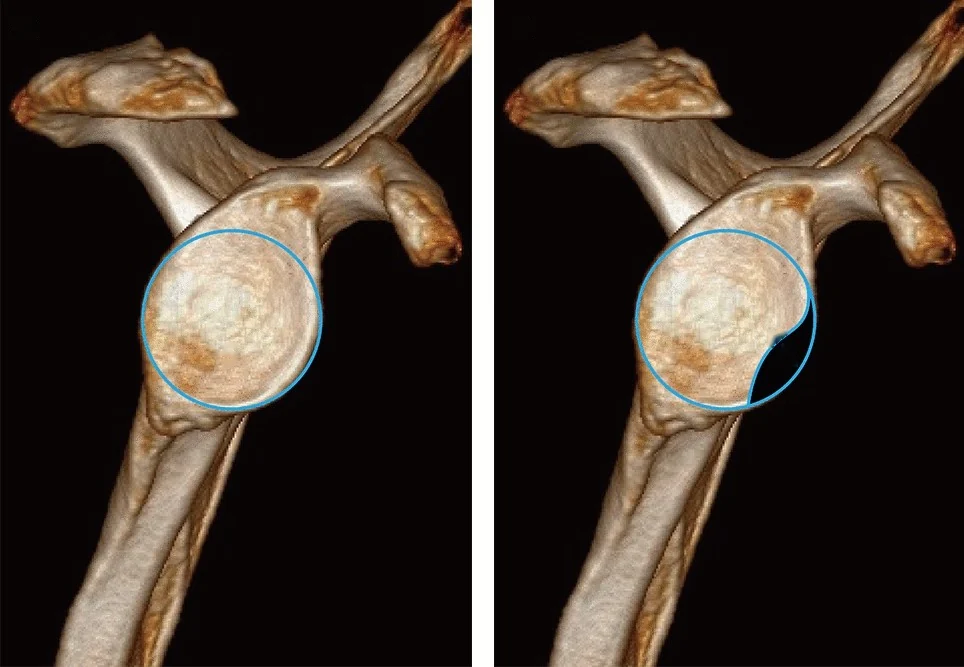
Each dislocation can shear a small amount of bone off the rim of the socket (glenoid) and create an indentation in the back of the ball (humerus). As that bone is lost, the socket becomes shallower and the shoulder loses the bony containment that keeps it in place. This is why the number of dislocations matters, not just whether the labrum is torn.
Beyond a certain amount of bone loss, repairing the labrum alone is unlikely to keep the shoulder stable, and rebuilding the bone becomes necessary. This is the central question in planning your surgery and it is why a CT scan is often obtained. Repeated dislocations while waiting generally make the problem harder to solve, not easier.
Your Treatment Options
There is no single right answer for every patient. The decision depends on your age, the number of dislocations you have had, how much bone has been lost, the sport or work you are returning to, and your goals.
Nonoperative Treatment
A short period of rest and protection after a dislocation, followed by structured physical therapy focused on the rotator cuff and shoulder blade muscles that help hold the shoulder centered. Activity modification is often part of the plan.
Return to sport without surgery:
- A sling is usually worn only for comfort for about 1 to 2 weeks, and therapy starts within days.
- Athletes who return in season can often play again at around 2 to 4 weeks if they have full motion, strength and the ability to protect themselves, but there is a high likelihood of another episode that season.
- Each additional dislocation also increases the risk that a later surgery will fail and can wear away more bone, which may change the type of surgery needed.
May be appropriate if:
- You had a first dislocation and are older or not returning to contact sport
- Your instability is multidirectional and related to generalized looseness
- There is little or no bone loss and your shoulder feels stable day to day
- You prefer to avoid surgery and the recovery it requires
Surgical Treatment
When there is little bone loss, an arthroscopic Bankart repair reattaches the torn labrum and ligaments to the rim of the socket using small anchors. When significant bone has been lost, the socket itself needs to be rebuilt. Options include a bone graft, such as a distal tibial allograft, or a Latarjet procedure, which transfers a piece of bone from the shoulder blade. A remplissage, which fills in the dent on the back of the ball, may also be added to reduce the risk of the shoulder dislocating again in both scenarios.
Often recommended if:
- You have had recurrent dislocations or subluxations
- You are young and returning to contact or collision sport even after a first dislocation
- There is meaningful bone loss from the socket or the ball
- Instability limits your work, sport, or daily activities
For multidirectional instability without a clear injury, physical therapy is the primary treatment and is often successful. For young athletes after a traumatic dislocation, the risk of recurrence is high enough that stabilization is frequently discussed early.
Recovery and Return to Sport
Recovery and Return to Activity
- You will wear a sling for several weeks after either type of surgery to protect the repair or allow the bone graft to heal.
- Motion is restored gradually, followed by strengthening. Pushing range of motion too early can compromise the result.
- Sport-specific rehabilitation usually begins around 3 months. Throwing typically starts around 4½ months and throwing from the mound around 6 months. Contact sports usually return at about 6 to 9 months. These are estimates that vary from person to person, and clearance is guided by strength, motion, and confidence rather than time alone.
- Most patients regain a stable shoulder and return to their activities, though some lose a small amount of external rotation.
- Rehabilitation is the single most important factor you control!
Risks to Understand
- Though rare, instability can recur after either procedure. Recurrence is more likely in younger patients and those returning to collision sport.
- Some loss of external rotation is common, particularly after bone grafting procedures.
- Bone grafting procedures carry additional risks related to graft healing and the hardware used to hold it.
- Other risks include stiffness, infection, nerve irritation, and problems related to anesthesia. This will be discussed in more detail prior to surgery.
- Smoking and nicotine use and consistent marijuana use are associated with poorer healing.
Selected Background Sources
The guidance in this handout reflects current peer-reviewed orthopedic literature and professional society recommendations. Selected sources include:
- American Academy of Orthopaedic Surgeons / American Shoulder and Elbow Surgeons. Shoulder Dislocation and Chronic Shoulder Instability. OrthoInfo.
- Adam M, et al. Arthroscopic Bankart repair for the acute anterior shoulder dislocation: systematic review and meta-analysis. Int Orthop. 2018.
- Bulleit CH, et al. Risk factors for recurrence following arthroscopic Bankart repair: systematic review. J Shoulder Elbow Surg. 2024.
- Warner T, et al. Risk factors for recurrent instability after arthroscopic Bankart repair in pediatric and adolescent patients: systematic review. Am J Sports Med. 2025.
- Abdul-Rassoul H, et al. Return to sport after surgical treatment for anterior shoulder instability: systematic review. Am J Sports Med. 2019.
- Entessari M, et al. Management of labral tears associated with glenohumeral instability in athletes. Curr Rev Musculoskelet Med. 2026.
- Kearney RS, et al. Acute rehabilitation following traumatic anterior shoulder dislocation (ARTISAN): randomised controlled trial. BMJ. 2024.
- Alentorn-Geli E, et al. Age- and time-specific management of traumatic anterior shoulder instability: 2024 ESSKA-ESA formal consensus, part 2. Knee Surg Sports Traumatol Arthrosc. 2026.
- Singh M, et al. Distal tibial allograft for anterior shoulder instability: systematic review and meta-analysis. Am J Sports Med. 2025.
- Frank RM, et al. Latarjet versus distal tibial allograft: matched cohort analysis. Am J Sports Med. 2018.
- Gilat R, et al. Latarjet versus free bone block procedures: systematic review and meta-analysis. Am J Sports Med. 2021.
- Cho CH, et al. Complications related to Latarjet stabilization: systematic review. Am J Sports Med. 2023.
This handout is for education and does not replace the discussion with your surgeon. Ask Dr. Tummala about anything that applies to your specific shoulder.
Handouts for this condition
- Condition guideThe printable version of this pageOpen PDF
If you are having surgery
You will receive a guide to your specific operation at your visit. Read what to expect from Labral Repair (Bankart) With or Without Remplissage and Bone Block Shoulder Stabilization, including the instructions and therapy protocols for after surgery. The Preparing for Surgery Booklet is on the Having surgery page.