What Is the AC Joint?
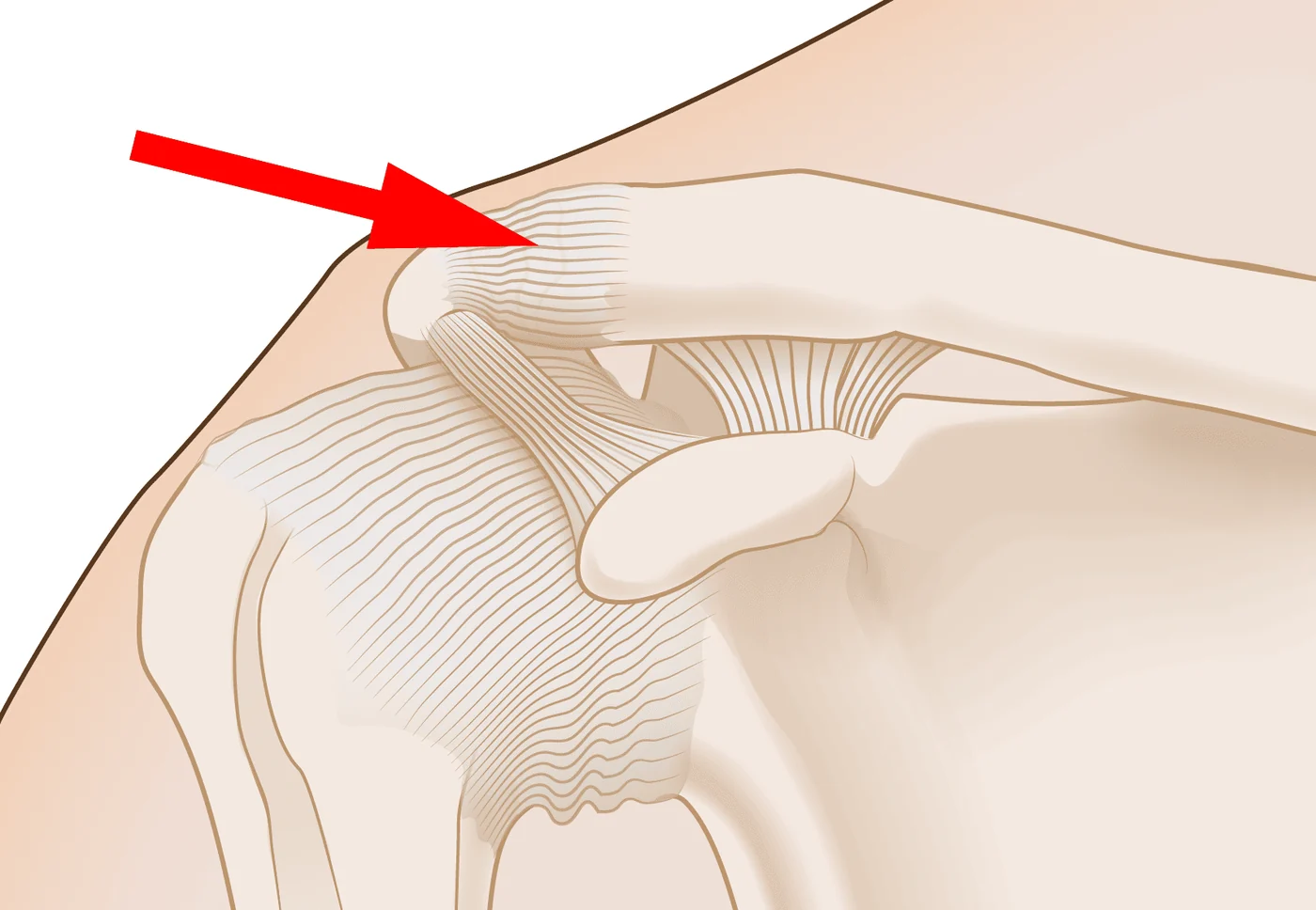
The acromioclavicular, or AC, joint is the small joint on top of the shoulder where the end of the collarbone (clavicle) meets a bony projection of the shoulder blade called the acromion. It is held together by ligaments that run directly across the joint, and by a second set of stronger ligaments that anchor the collarbone down to the shoulder blade from below.
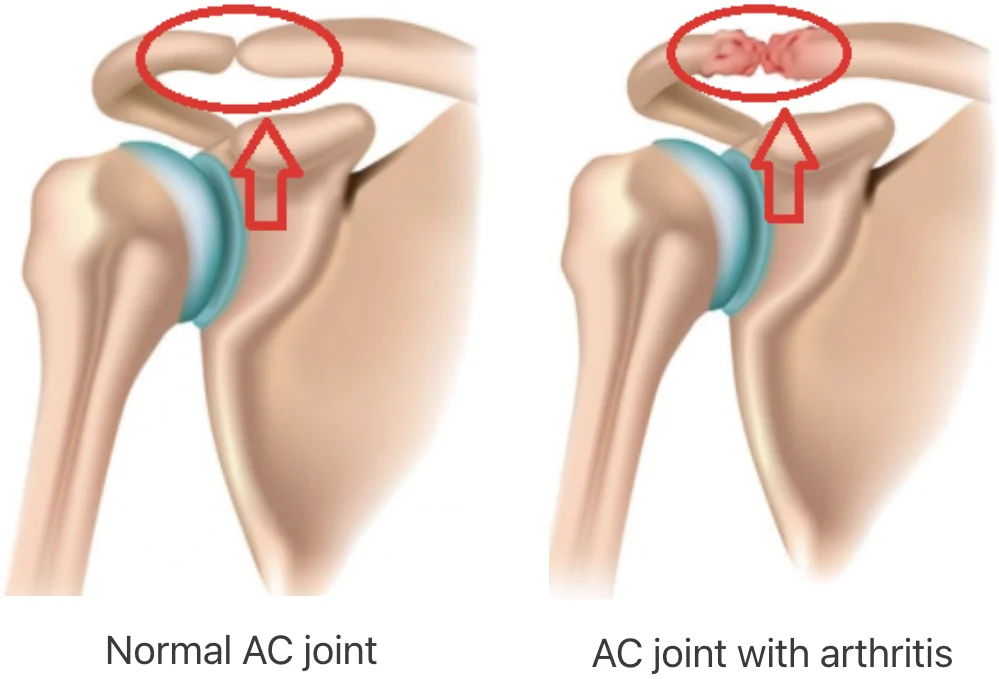
Two different problems commonly affect this joint. An AC joint separation happens suddenly, when a fall or blow tears the ligaments and the collarbone shifts out of position. Arthritis develops gradually, as the cartilage in the joint wears down. They look and feel quite different, but both cause pain localized to the top of the shoulder.
How AC Joint Problems Develop
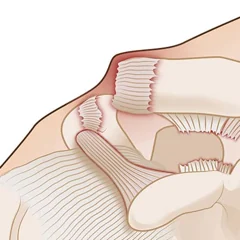
AC separations almost always come from a direct fall onto the point of the shoulder, most often in contact sport or cycling. The force drives the shoulder blade downward while the collarbone stays in place, tearing the ligaments that hold them together. How far the collarbone shifts determines the grade of the separation.

AC arthritis is different and develops over time, particularly in people who do heavy or repetitive overhead lifting. It also frequently follows a previous separation of the joint. This type of arthritis is very common and is often only noticed on X-rays in patients with no symptoms at all.
Common Symptoms
- Pain right on top of the shoulder that you can usually point to with one finger
- Pain reaching across your body, sleeping on that side, or pressing overhead
- After a separation there is often immediate pain, swelling, and a visible bump on top of the shoulder
- A sense that the collarbone moves or shifts with certain motions
- With arthritis there may be aching that builds after lifting and settles with rest
How It Is Diagnosed
- A detailed history, including any fall or injury and what activities provoke the pain
- Physical examination, including tenderness directly over the joint and pain when reaching across the body
- X-rays to assess the position of the collarbone and look for arthritis or bone changes
- Weighted or comparison X-rays in some cases to judge how much the collarbone has shifted
- MRI in selected cases particularly to evaluate the rotator cuff at the same time
 Types of AC Joint Problems
Ligaments are stretched or partly torn. The collarbone stays in a near-normal position.
Nonoperative care
Ligaments are torn and the collarbone is moderately elevated.
Most are treated nonoperatively. Surgery may be discussed as an option for athletes.
The collarbone is severely displaced, sometimes backward through muscle.
Surgery is generally recommended.
Cartilage in the joint wears down, often after years of overhead or heavy lifting.
Injection and activity modification first, followed by surgery if symptoms persist
The end of the collarbone breaks down from repetitive loading, common in weightlifters.
Activity modification first, followed by surgery if symptoms persist
About the Bump
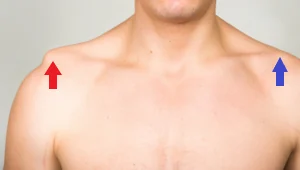
After a separation, many patients are left with a visible bump on top of the shoulder where the end of the collarbone sits higher than it used to. This is usually what patients notice and worry about most.
In most cases the bump is a cosmetic issue rather than a functional one. Many patients with a persistent bump have full strength and motion and return to everything they did before. Surgery can improve the appearance and the position of the collarbone, but for lower-grade separations the bump alone is generally not a reason to operate.
Your Treatment Options
There is no single right answer for every patient. The decision depends on whether the problem is a separation or arthritis, how far the collarbone has shifted, your work and sport demands, and how much your symptoms limit you.
Nonoperative Treatment
For separations, a sling for comfort, ice, and anti-inflammatory medication early on, followed by physical therapy to restore motion and strength. Injections may be considered in select cases.
For arthritis, activity modification and anti-inflammatory medication, with a corticosteroid or similar injection into the joint that can provide meaningful and sometimes durable relief.
May be appropriate if:
- You have a Type I or II separation
- You have a Type III separation and are not a high-level athlete or heavy laborer
- Your arthritis symptoms respond to injection and activity modification
- You prefer to avoid surgery and the recovery it requires
Most AC joint problems are managed without surgery. For lower-grade separations in particular, patients typically regain full function even if a bump remains.
Surgical Treatment
For a high-grade separation, the collarbone is brought back into position and held there while the ligaments heal, using strong sutures, buttons, or a tendon graft to reconstruct the ligaments that anchor the collarbone down.
For arthritis or osteolysis, a small amount of bone is removed from the end of the collarbone so the two bones no longer rub against each other. This is usually done arthroscopically, but may be done with a small open incision depending on the location of the bone spur. Only the needed, small amount is taken.
Often recommended if:
- You have a Type IV, V, or VI separation
- You have a Type III separation and are an athlete, particularly an overhead athlete, or have heavy work demands
- Arthritis pain persists despite injection, medication, and activity modification
- Pain is limiting your work, sport, or daily activities
Recovery and Return to Activity
Recovery Timeline
AC separation, treated without surgery:
- Most patients return to sport in about two weeks after a Type I separation, three to six weeks after a Type II, and six to twelve weeks after a Type III, once motion and strength are full and pain-free.
- Most patients treated without surgery return to full activity, though some notice minor aching with heavy overhead work.
AC separation, treated with reconstruction:
- After reconstruction of a high-grade separation, you will wear a sling for several weeks to protect the repair while the ligaments heal.
- Return to contact sport or heavy overhead lifting after a reconstruction is typically four to six months out.
AC arthritis, treated with surgery:
- After removal of the end of the collarbone, recovery is relatively quick, with return to most activities over several weeks and return to sport in about six to twelve weeks.
- Rehabilitation is the single most important factor you control!
Risks to Understand
- After reconstruction, the collarbone can gradually settle back up over time. Some loss of the correction is not uncommon.
- Removing too much bone from the end of the collarbone in AC joint arthritis can leave the joint unstable and painful, which is why only a small amount is taken.
- Hardware used to hold the collarbone in position can occasionally be prominent or require removal.
- Other risks include infection, nerve irritation, stiffness, fracture, and problems related to anesthesia. This will be discussed in more detail prior to surgery.
- Smoking and nicotine use and consistent marijuana use are associated with poorer healing.
Selected Background Sources
The guidance in this handout reflects current peer-reviewed orthopedic literature and professional society recommendations. Selected sources include:
- Tamaoki MJ, et al. Surgical versus conservative interventions for acromioclavicular dislocation: Cochrane review. Cochrane Database Syst Rev. 2019.
- Murray IR, et al. Open reduction and tunneled suspensory device fixation versus nonoperative treatment for Type III/IV AC dislocations: ACORN randomized trial. J Bone Joint Surg Am. 2018.
- Gowd AK, et al. Operative management of acromioclavicular joint dislocations: systematic review and meta-analysis. Am J Sports Med. 2019.
- Chen RE, et al. Complications after operative treatment of high-grade acromioclavicular injuries. J Shoulder Elbow Surg. 2023.
- Soler F, et al. Conservative versus surgical management of acromioclavicular joint osteoarthritis: scoping review. Knee Surg Sports Traumatol Arthrosc. 2021.
- Pensak M, et al. Open versus arthroscopic distal clavicle resection: systematic review. Arthroscopy. 2010.
- Hossain S, et al. Long-term effectiveness of steroid injections in primary AC joint arthritis. J Shoulder Elbow Surg. 2008.
- Beitzel K, et al. Sequential resection of the distal clavicle and its effects on horizontal AC translation. Am J Sports Med. 2012.
- Li X, et al. Management of acromioclavicular joint injuries. J Bone Joint Surg Am. 2014.
- Elliott WC, et al. Return to sport after acromioclavicular injury: a systematic review of modifiable factors. J Clin Med. 2025.
This handout is for education and does not replace the discussion with your surgeon. Ask Dr. Tummala about anything that applies to your specific shoulder.
Handouts for this condition
- Condition guideThe printable version of this pageOpen PDF
If you are having surgery
You will receive a guide to your specific operation at your visit. Read what to expect from AC Joint and Distal Clavicle Surgery and Clavicle and Shoulder Fracture Surgery, including the instructions and therapy protocols for after surgery. The Preparing for Surgery Booklet is on the Having surgery page.