Surgery is considered when it is the right choice for you. Before your operation you will receive a Preparing for Surgery booklet and a detailed guide related to your specific procedure.
Overview
The shoulder is a ball (humerus) and socket (glenoid) joint with a shallow socket. This inherent dynamic is what lets the shoulder move so freely and also what makes it more likely to come out compared to other joints. Each time the shoulder dislocates, in addition to injury to the soft tissue structures (labrum and ligaments), bone can also be worn off the front rim of the socket. Over time, as more bone wears off, the socket may be too shallow to hold the ball in consistently. A bone block operation rebuilds the missing front wall of the socket which deepens the socket and restores the bumper that keeps the ball centered.
- This operation is recommended because of bone loss on the socket (glenoid) combined with your risk factors for repeat dislocation.
- Recurrence rates are lower than with a soft tissue repair (Bankart repair) when bone is missing.
Technique
- Done through an incision at the front of the shoulder.
- The joint is inspected and the amount and location of bone loss is confirmed directly.
- The muscle layer at the front of the shoulder (subscapularis) is split, but preserved, to reach the joint. It is repaired at the end.
- A free bone block is prepared, or the graft is harvested from the coracoid and prepared (Latarjet).
- The graft is positioned flush with the edge of the socket and fixed with screws or cerclage.
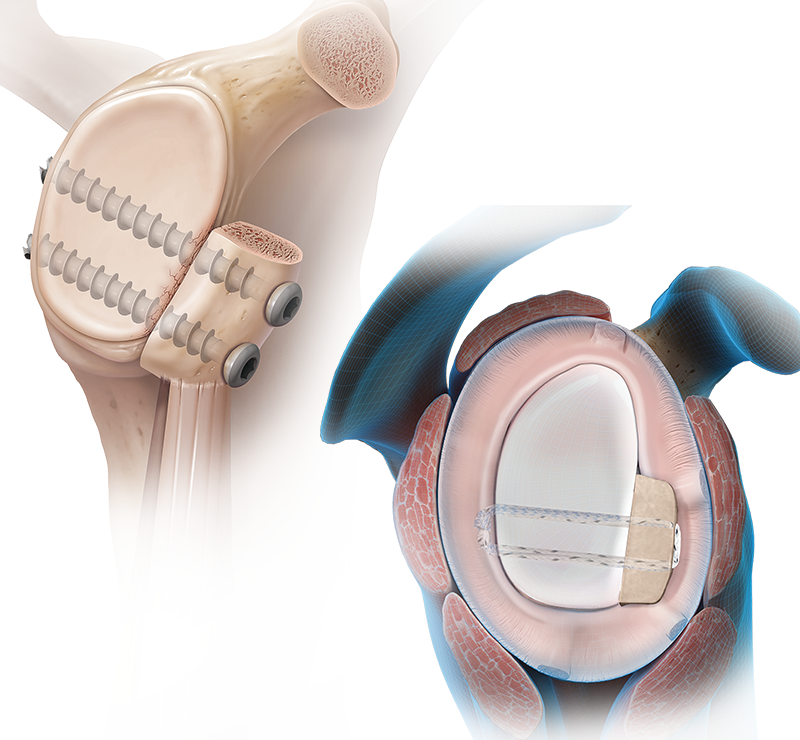
Latarjet (left) and distal tibia allograft (right)
Recovery
Getting Back to Activity
- Weeks 1-2Sling, protected motion only
- Weeks 3-9Sling weaned, motion returns
- Weeks 10-15Strengthening to chest level
- Weeks 16-20Overhead work, return to activity
- Month 6Contact sport
Recovery Milestones
- Sling: Weaned from about 3 weeks.
- Desk work: Early weeks.
- Golf: 12 weeks, chipping and putting only at first.
- Tennis: 16 weeks, nothing overhead.
- Throwing: 16 weeks, as an interval program.
- Contact sport: 6 months.
Progress is guided by motion, strength, graft healing and confidence rather than time alone.
- Weight lifting has specific restrictions. Avoid tricep dips, wide grip bench press, military press and lat pulldowns behind the head. A simple rule is that you should always be able to see your elbows. Push-ups are allowed once cleared, as long as the elbows do not bend past 90 degrees.
- You may be asked to have a CT scan before returning to contact sport to confirm the graft has healed to the socket.
For how this condition is diagnosed and every treatment option, including nonoperative care, read the full Shoulder Instability guide.
Instructions and therapy protocols
Each version of this operation has its own post-op instructions and physical therapy protocol. Bring the protocol to your first therapy visit.
- Anterior Shoulder StabilizationPost-op instructionsPT protocol