Two Ways to Replace a Shoulder
An anatomic replacement rebuilds the shoulder the way it is in your body currently. A smooth metal ball replaces the worn ball (humerus) on the arm bone and a new socket resurfaces the old socket (glenoid). It is dependent on a working rotator cuff to lift and rotate the arm.
A reverse replacement switches the arrangement. The ball is placed on the socket (glenoid) and the socket on the ball (humerus). This changes the mechanics so that the deltoid, the large muscle over the outside of the shoulder, can lift the arm even when the rotator cuff cannot.
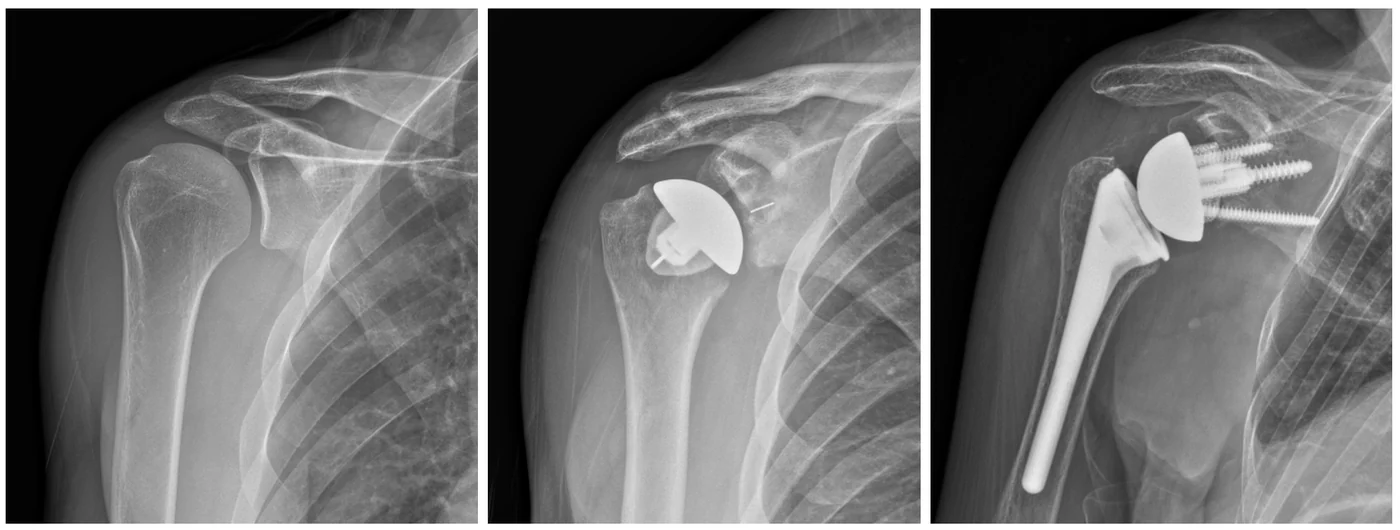
When the rotator cuff is badly torn or not functional, the decision is more straightforward and a reverse replacement is commonly used. The more challenging situation is for patients whose rotator cuff is still working. Both operations are excellent options and they trade off against each other in ways worth understanding before making a decision.
What Tends to Point Toward Each Option
Toward an anatomic replacement
- Your rotator cuff is intact and functioning well
- You have great motion before surgery
- Reaching behind your back and rotating the arm matter a great deal to you
- You want to return to sport or higher-demand activity8
- You are younger
Toward a reverse replacement
- Your rotator cuff is torn beyond repair or not functioning
- Your shoulder is stiff with limited motion before surgery
- There is significant wear or deformity of the socket
- You are older, when results are similar and repeat surgery is less common
- Avoiding a second operation matters more to you than maximum rotation
How They Compare
Excellent and reliable.
Matched studies consistently find no meaningful difference between the two in pain scores or satisfaction.1,2
Equally excellent.
Satisfaction is high with both, over 90% in matched studies.4
Very good and generally the same as reverse.
One matched study found 149° versus 142°, which may be a difference that is hard to notice.1
Very good.
May be better than anatomic if your shoulder was stiff.1,5
Better, and by enough that patients can often tell.
Typically there is 6 to 10 degrees more external rotation.1,6
More limited.
The gap is consistent across studies.2,6
Clearly better.
This is the most noticeable functional difference. About two in three patients could reach their lower back afterward (69%).1
More limited.
About one in three (37%) patients could reach their lower back. This comes from how the reverse works mechanically and not from surgical technique.1,7
About 5%.2,9
About 2%.2,9,10
The socket loosens and the rotator cuff wears out slowly over years.
Usually after five years or more.11
Instability, stress fractures and wear where the implant may contact bone.
Usually within the first year or two.12
6 in 10017
Higher in patients under 55.13
4 in 10017
Beyond fifteen years there is very little information to evaluate.12
Converts more easily to a reverse replacement.
About 8 in 10 are still working ten years later (82%).14
Revision dependent on remaining bone stock.
About 6 in 10 revised reverse replacements are still working at ten years (60%).14
No randomized trial has compared these two operations. The numbers above come from groups of patients who differed to begin with and reverse replacements only have good information out to about five years.2,12
Why Age Matters in This Decision
- After an anatomic replacement the rotator cuff gradually wears with time. This is a main reason anatomic replacements eventually fail.11 About 84% of anatomic replacements are free of rotator cuff problems at 10 years and about 45% at 15 years.11
- Older or lower-demand patients: the implant will likely outlast the demand placed on it. This favors a reverse even when the rotator cuff is intact.3
- Younger or higher-demand patients: an anatomic gives slightly better rotation and function now. If it fails later it can be converted to a reverse replacement. Starting with a reverse may leave fewer options later.13
The Short Version
Both operations reliably relieve pain, and more than 96% of patients in matched studies reach a meaningful improvement with both options.15
An anatomic replacement generally gives:
- Better rotation
- Better function reaching behind your back
- A higher ceiling for returning to activity
- A better fallback if it ever needs revision
A reverse replacement generally has:
- Fewer early complications
- A lower revision rate in the first ten years
- Does not rely on the rotator cuff to work well
Neither is clearly better or worse.16 The right choice depends on your rotator cuff, the shape and wear of your socket, how stiff your shoulder is now, your age, and what you need the arm to do. Dr. Tummala will go through your imaging and your goals with you before deciding together.
Selected Background Sources
Reflects current peer-reviewed literature and professional society recommendations:
- 1. Kirsch JM, et al. Outcomes after anatomic and reverse shoulder arthroplasty for glenohumeral osteoarthritis: propensity score-matched analysis (n=134). J Bone Joint Surg Am. 2022.
- 2. Friedman RJ, et al. Comparison of reverse and anatomic total shoulder arthroplasty in patients with an intact rotator cuff and no previous surgery (n=740 matched). J Am Acad Orthop Surg. 2022.
- 3. Gupta MS, et al. Reverse versus anatomic total shoulder arthroplasty in patients over 70 with a competent rotator cuff: meta-analysis (8 studies, 1,716 patients). J Shoulder Elbow Surg. 2026.
- 4. Ardebol J, et al. Patients 75 years or older with primary glenohumeral arthritis and an intact rotator cuff show similar clinical improvement. J Shoulder Elbow Surg. 2024.
- 5. Trammell AP, et al. Clinical outcomes of anatomical versus reverse total shoulder arthroplasty in patients with primary osteoarthritis, an intact rotator cuff, and limited forward elevation. Bone Joint J. 2023.
- 6. Mousad AD, et al. Anatomic and reverse total shoulder arthroplasty for osteoarthritis in patients 80 years and older. J Shoulder Elbow Surg. 2025.
- 7. Shi BY, et al. Superior internal rotation after anatomic versus reverse shoulder arthroplasty performed with lesser tuberosity osteotomy. J Shoulder Elbow Surg. 2026.
- 8. Liu JN, et al. Return to sport after shoulder arthroplasty: systematic review and meta-analysis (13 studies, 944 patients). Knee Surg Sports Traumatol Arthrosc. 2018.
- 9. Marigi EM, et al. Anatomic versus reverse total shoulder arthroplasty for primary osteoarthritis: case controlled comparisons (n=734). J Shoulder Elbow Surg. 2023.
- 10. Daher M, et al. Reverse versus anatomic total shoulder arthroplasty for glenohumeral osteoarthritis with intact cuff: a meta-analysis of clinical outcomes. J Shoulder Elbow Surg. 2025.
- 11. Young AA, et al. Secondary rotator cuff dysfunction following total shoulder arthroplasty for primary glenohumeral osteoarthritis (n=518, mean 8.6 years). J Bone Joint Surg Am. 2012.
- 12. Valsamis EM, et al. Reverse versus anatomical total shoulder replacement for osteoarthritis: National Joint Registry population cohort study. BMJ. 2024.
- 13. Jomaa M, et al. Stemless anatomic and reverse shoulder arthroplasty in patients under 55 years of age: Australian Orthopaedic Association National Joint Replacement Registry at 5 years. J Shoulder Elbow Surg. 2026.
- 14. Patel R, et al. Revision reverse shoulder arthroplasty after failed shoulder arthroplasty: long-term survivorship and risk factors for failure. J Shoulder Elbow Surg. 2026.
- 15. Leinweber KA, et al. Reverse and anatomic total shoulder arthroplasty for glenohumeral osteoarthritis: a propensity-matched comparison at early and midterm follow-up. J Shoulder Elbow Surg. 2026.
- 16. Khazzam MS, Pearl ML. AAOS Clinical Practice Guideline: Management of Glenohumeral Joint Osteoarthritis. J Am Acad Orthop Surg. 2020.
- 17. O'Malley O, et al. Is there a difference in thresholds for revision between shoulder arthroplasty types? A National Joint Registry study (10-year revision 6.4% anatomic, 4.4% reverse). PLoS One. 2025.
This handout is for education and does not replace the discussion with your surgeon.
Handouts for this condition
- Condition guideThe printable version of this pageOpen PDF
If you are having surgery
You will receive a guide to your specific operation at your visit. Read what to expect from Anatomic Shoulder Replacement and Reverse Shoulder Replacement, including the instructions and therapy protocols for after surgery. The Preparing for Surgery Booklet is on the Having surgery page.