What Is Frozen Shoulder?
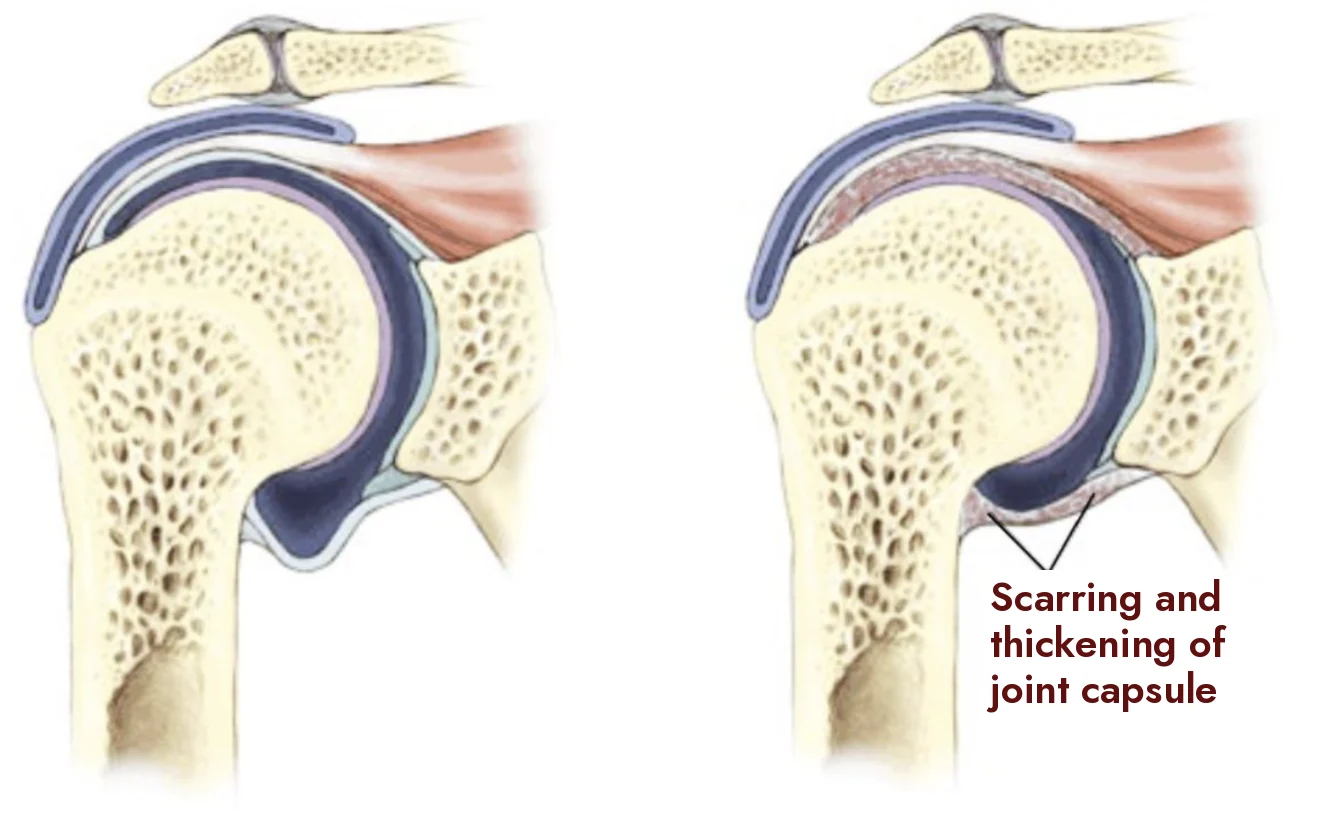
The shoulder joint is surrounded by a flexible envelope of tissue called the capsule which normally allows the joint to move freely and is lubricated by fluid inside. In frozen shoulder, also called adhesive capsulitis, this capsule becomes inflamed, thickened, and tight. Bands of scar tissue form and the lubricating fluid decreases.
The result is a shoulder that becomes painful and progressively stiff. The defining feature is that the shoulder is stiff in all directions and the pain can limit you from doing your daily activities.
Who Gets Frozen Shoulder
Frozen shoulder most often affects people between roughly 40 and 60 years of age, and occurs more commonly in women than in men. It frequently comes on without any injury at all or a minor trauma which patients often find surprising and frustrating.
Diabetes is the strongest risk factor. Patients with diabetes develop frozen shoulder considerably more often, tend to be stiffer, and typically take longer to recover. Thyroid disease and heart disease are also associated with frozen shoulder. A frozen shoulder can also follow a period when the arm was held still after an injury or surgery, which is one reason early motion is encouraged after most shoulder procedures.
Common Symptoms
- A dull, aching pain over the outer shoulder that may extend into the upper arm
- Pain that is worse with movement
- Night pain that makes it difficult to sleep, particularly on that side
- Progressive stiffness in every direction, especially rotating the arm outward
- Difficulty with everyday tasks such as reaching behind your back, fastening a seatbelt, or putting on a coat
How It Is Diagnosed
- A detailed history of how your symptoms started and how they have changed
- Physical examination, comparing the motion you have on your own with the motion when the arm is moved for you. Loss of both is the hallmark of frozen shoulder
- X-rays, which are usually normal but help rule out arthritis or other causes of stiffness
- MRI or ultrasound in selected cases, mainly to rule out a rotator cuff tear or other problem
- Blood work in some cases to screen for diabetes or thyroid disease if not already known
The Three Stages
| Stage | What Happens |
|---|---|
Freezing | Pain builds steadily and motion is progressively lost. This is usually the most painful stage. Several months. |
Frozen | Pain often begins to settle, but the stiffness remains and daily activities are difficult. Several months. |
Thawing | Motion gradually returns, often slowly and unevenly. Several months to a couple of years. |
What to Expect Over Time
Frozen shoulder tends to improve over time, but the process is slow and can take a year or longer from start to finish. This is the hardest part for most patients and patience is critical. Pushing through aggressive stretching during the painful early stage often makes symptoms worse rather than better.
It is also worth knowing that not everyone returns completely to normal and some patients are left with a small degree of residual stiffness. If you have diabetes, keeping your blood sugar well controlled is one of the most useful things you can do, as better glucose control is associated with a smoother and often faster recovery.
Your Treatment Options
Treatment depends heavily on which stage you are in. Early on, the priority is controlling pain. Later, once the pain has settled, the priority shifts to restoring motion.
Nonoperative Treatment
The foundation of treatment is a consistent home stretching program, which you will be given. The key is to stretch gently to the point where you feel a stretch but not pain, and to do it consistently several times a day. Formal physical therapy is an adjunct rather than a requirement, and is most useful if you are struggling on your own or want help performing the exercises correctly. Anti-inflammatory medication and a corticosteroid injection into the joint can also be considered, and are most useful during the painful early stage.
May be appropriate if:
- You are early in the course and pain is the dominant problem
- Your motion is improving, even slowly
- Injections and therapy are giving you meaningful relief
- You prefer to avoid surgery and the recovery it requires
The large majority of patients improve without surgery. Consistency matters far more than intensity: gentle daily stretching does more for a frozen shoulder than occasional forceful stretching, which usually sets you back.
Surgical Treatment
Surgery is generally considered once the painful stage has settled but stiffness persists despite a genuine course of therapy and injection.
Dr. Tummala performs an arthroscopic capsular release, in which the tight capsule is precisely divided under direct vision through small incisions, combined with a gentle manipulation to confirm that full motion has been restored before you leave the operating room. Combining the two allows a controlled release rather than relying on force alone.
Often recommended if:
- Stiffness and pain persist despite several months of therapy and failed nonoperative management
- The stiffness is significantly limiting your work or daily activities
- The frozen shoulder followed surgery or injury and is not resolving on its own
What to Expect After Surgery
Recovery and Return to Activity
- Motion begins immediately, often the same day, because the window to keep the motion gained in surgery is short. A sling may be used temporarily for comfort only.
- Therapy starts almost immediately and is intensive early on with home exercises several times daily.
- Most patients notice a substantial improvement in motion right away, with continued gains over the following months.
- Most return to normal activities within a few months, though full recovery can take longer.
- Rehabilitation is the single most important factor you control!
Risks to Understand
- Stiffness can return, particularly if therapy is not kept up in the first weeks after surgery.
- Patients with diabetes are more likely to have some residual stiffness, and recovery is often slower.
- Frozen shoulder can occasionally recur, especially when a contributing condition such as diabetes remains poorly controlled.
- Other risks include infection, nerve irritation, fracture, and problems related to anesthesia. This will be discussed in more detail prior to surgery if indicated.
- Smoking and nicotine use and consistent marijuana use are associated with poorer healing.
Selected Background Sources
The guidance in this handout reflects current peer-reviewed orthopedic literature and professional society recommendations. Selected sources include:
- American Academy of Orthopaedic Surgeons / American Shoulder and Elbow Surgeons. Frozen Shoulder. OrthoInfo.
- Rangan A, et al. Manipulation under anaesthesia versus capsular release versus physiotherapy with steroid injection: UK FROST randomized trial. Lancet. 2020.
- Challoumas D, et al. Comparison of treatments for frozen shoulder: systematic review and meta-analysis. JAMA Netw Open. 2020.
- Sun Y, et al. Intra-articular steroid injection for frozen shoulder: systematic review and meta-analysis. Am J Sports Med. 2017.
- Zhang J, et al. Comparative efficacy of nonsurgical treatment strategies: network meta-analysis. Am J Sports Med. 2021.
- Vastamäki H, et al. Natural history of idiopathic frozen shoulder. Clin Orthop Relat Res. 2012.
- Wong CK, et al. Natural history of frozen shoulder: fact or fiction? Systematic review. Physiotherapy. 2017.
- Cho CH, et al. Capsular release in diabetic versus idiopathic frozen shoulder. Arthroscopy. 2016.
- Mehta SS, et al. Capsular release in patients with and without diabetes. Bone Joint J. 2014.
This handout is for education and does not replace the discussion with your surgeon. Ask Dr. Tummala about anything that applies to your specific shoulder.