What Is the Rotator Cuff?
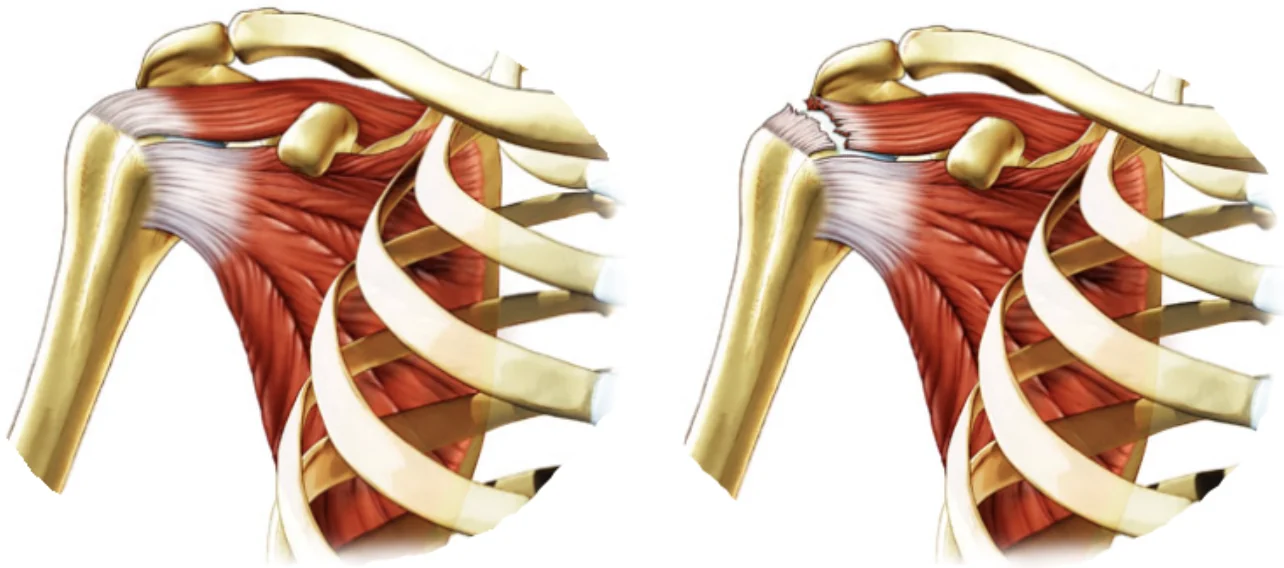
The rotator cuff is a group of four muscles and their tendons that surround the shoulder joint. Together they hold the ball of the shoulder centered in its socket and allow you to lift and rotate your arm. A lubricating sac called the bursa sits between the cuff and the bone above it (the acromion). When the cuff is irritated or torn, this bursa often becomes inflamed as well, which contributes to shoulder pain.
A rotator cuff tear means one or more of these tendons has partially or completely pulled away from the bone. Partial thickness tearing can be thought of as a rope fraying over time weakening the integrity of the tendon attachment. A torn tendon does not reattach to the bone on its own. Many tears can be managed successfully without surgery, while others are best treated with repair. Which path is right depends on your symptoms, the tear itself, and your goals.
How Rotator Cuff Tears Happen
Rotator cuff tears occur in two general patterns. Some happen suddenly, from a fall onto an outstretched arm or lifting something heavy. Others develop gradually as the tendon wears down. Sometimes a small injury or sudden movement can cause the weakened tendon to tear acutely. Wear-related tears are the more common of the two, and they usually begin as fraying before progressing to a tear.
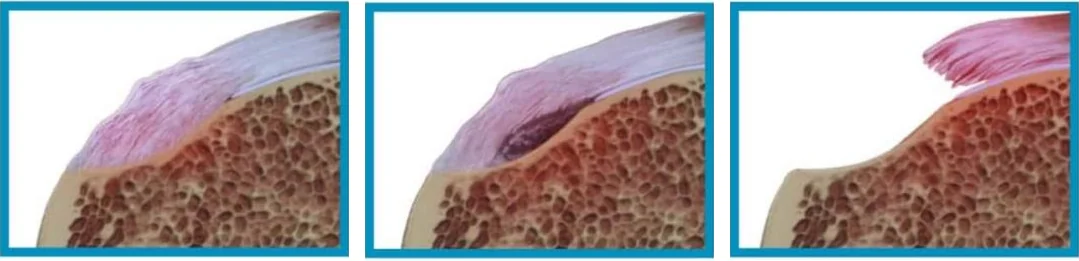
Tears become considerably more common with age, in part because blood supply to the tendon decreases over time. They occur more often in the dominant arm, and a wear-related tear on one side raises the likelihood of a tear on the other, even without pain there. Many people have a tear and no symptoms at all. Finding one on an MRI does not automatically mean it is the cause of your pain or that it needs repair. Other contributing factors include repetitive overhead work or sport, smoking and nicotine use, and diabetes.
Common Symptoms
- Pain over the outside or front of the shoulder, often worse with reaching overhead or behind your back
- Pain at night, particularly when lying on that shoulder
- Weakness when lifting or rotating the arm
- Difficulty with everyday tasks such as dressing, washing your hair, or reaching a shelf
- A catching, grinding, or crackling sensation with movement
How It Is Diagnosed
- A detailed history of your symptoms and any injury
- Physical examination, including specific strength and motion tests for each tendon
- X-rays to assess bone spurs, the position of the ball in the socket, and any arthritis
- MRI or ultrasound to confirm the tear and show its size, how far the tendon has pulled back, and the quality of the muscle
Types of Rotator Cuff Tears
Some tendon fibers are damaged, but the tendon is still attached to the bone.
Often managed without surgery unless refractory to nonoperative care
The tendon has pulled away from the bone over a limited area.
Both nonoperative care and repair can work well
A larger detachment, often involving more than one tendon and more tendon retraction.
Repair is more complex and results are more variable
Longstanding tear with muscle wasting, fatty change, or associated shoulder arthritis.
Repair may not be possible and other options such as a shoulder replacement or tendon transfer are considered
Why Tear Size and Timing Matter
A torn rotator cuff tendon does not reattach to the bone on its own, and tears can enlarge over time. As a tear gets larger and the tendon pulls further back, the muscle it belongs to can begin to waste and fill in with fat. Those muscle changes are not reversible, even with a successful repair.
This does not mean every tear needs surgery, or needs it right away. Many tears remain stable and many patients do well without an operation. It does mean that if repair is being considered, it is generally better done while the tendon and muscle are still healthy. If we choose to watch a tear, we do so deliberately with follow-up and, when appropriate, repeat imaging.
Your Treatment Options
There is no single right answer for every patient. The decision depends on the type and size of your tear, how much pain and weakness you have, your age and activity level, the quality of the tendon and muscle, and your goals.
Nonoperative Treatment
Structured physical therapy to strengthen the remaining cuff and surrounding muscles to improve shoulder mechanics. Activity modification and anti-inflammatory medication if indicated. A corticosteroid injection can help many patients, though not everyone responds and the duration of relief decreases over time.
May be appropriate if:
- You have a partial-thickness or smaller full-thickness tear
- Your main problem is pain rather than significant weakness or loss of motion
- You have a chronic tear with muscle changes that make repair unlikely to heal
- You prefer to avoid surgery and the recovery it requires
Most patients improve substantially with therapy alone, and for many this remains the right long-term choice. Therapy does not heal the tear, but it can meaningfully reduce pain and restore function. The tradeoff is that the tear may enlarge over time and some activities may need to be limited.
Surgical Reconstruction
The torn tendon is reattached to the bone. This is done arthroscopically through small incisions. The repair technique is individualized based on the size and pattern of your tear and the quality of the tissue. Other findings may be addressed at the same time, such as biceps tendon problems, bone spurs, or arthritis of the acromioclavicular joint of the shoulder. When a tear cannot be repaired, other reconstructive options may be discussed.
Often recommended if:
- You have an acute tear from a specific injury, particularly with significant weakness and loss of motion
- Pain and weakness persist after a genuine course of therapy, often over several months
- The tear is full-thickness and the tendon and muscle quality remain good
- You need the shoulder for work, sport, or daily activities that therapy has not restored
What to Expect After Repair
Recovery and Return to Activity
- Pain relief is generally the most reliable result of surgery. Strength and range of motion return more slowly and are less predictable.
- You will wear a sling for several weeks to protect the repair while the tendon heals to the bone.
- The tendon needs this time to heal regardless of how good the shoulder feels. Doing too much too early risks the repair.
- Most patients return to everyday activities within a few months, with continued improvement in strength over the following year.
- Rehabilitation is the single most important factor you control!
Risks to Understand
- The repair can fail to heal or re-tear. This is more likely with larger tears, poorer tendon quality, and older age.
- Even when a repair does not fully heal, many patients still have meaningful pain relief and improved function.
- Shoulder stiffness is common early on and usually improves with therapy, though occasionally it requires further treatment.
- Other risks include infection, nerve irritation, and problems related to anesthesia. This will be discussed in more detail prior to surgery.
- Smoking and nicotine use, poorly controlled diabetes, and consistent marijuana use are associated with poorer tendon healing.
Selected Background Sources
The guidance in this handout reflects current peer-reviewed orthopedic literature and professional society recommendations. Selected sources include:
- Brown GA, et al. Management of Rotator Cuff Injuries: Evidence-Based Clinical Practice Guideline. AAOS. 2025.
- Kuhn JE, et al. Effectiveness of physical therapy in treating atraumatic full-thickness rotator cuff tears. J Shoulder Elbow Surg. 2013.
- Kuhn JE, et al. Predictors of surgery: 10-year outcomes of the MOON Shoulder cohort. J Bone Joint Surg Am. 2024.
- Moosmayer S, et al. Tendon repair compared with physiotherapy at 10 years. J Bone Joint Surg Am. 2019.
- Lawrence RL, et al. Asymptomatic rotator cuff tears. JBJS Rev. 2019.
- Le BT, et al. Factors predicting rotator cuff retears: analysis of 1,000 consecutive repairs. Am J Sports Med. 2014.
- Davey MS, et al. Arthroscopic rotator cuff repair at 10-year follow-up: systematic review. Arthroscopy. 2023.
This handout is for education and does not replace the discussion with your surgeon. Ask Dr. Tummala about anything that applies to your specific shoulder.
Handouts for this condition
- Condition guideThe printable version of this pageOpen PDF
- Home exercise programExercises with pictures and a progress logOpen PDF
- Physical therapy protocolNonoperative plan to bring to your therapistOpen PDF
If you are having surgery
You will receive a guide to your specific operation at your visit. Read what to expect from Rotator Cuff Repair and AC Joint and Distal Clavicle Surgery, including the instructions and therapy protocols for after surgery. The Preparing for Surgery Booklet is on the Having surgery page.