Surgery is considered when it is the right choice for you. Before your operation you will receive a Preparing for Surgery booklet and a detailed guide related to your specific procedure.
Overview
The shoulder is a ball and socket joint with a shallow socket. This is what lets it move so freely and also what makes it prone to coming out. A rim of cartilage called the labrum deepens the socket and anchors the ligaments. When the shoulder dislocates forward, the labrum and ligaments often tear off the front of the socket. This is called a Bankart lesion and it increases the risk of your shoulder continuing to dislocate. Dislocations can also leave a dent in the back of the ball. When that dent is significant, a second procedure called a remplissage is often added to the repair to improve stability, particularly in higher risk patients.
- The goal of this surgery is to restore the front bumper (labrum) and the tension of the ligaments.
- A remplissage may be added for additional stability. This is done through the same incisions.
Technique
- Done arthroscopically through several small incisions with a camera and arthroscopic instruments.
- The whole joint is inspected first, including the labrum, the ligaments, the cartilage and the back of the humeral head.
- The torn labrum is freed up and the bone edge of the socket is prepared so the tissue can heal back to it.
- Anchors are placed into the rim of the socket and the sutures attached to them are passed through the labrum and tied, pulling it back onto the bone and retensioning the ligaments.
- When needed, a remplissage is done at the same time by securing the rotator cuff tendon and capsule into the back of the ball.
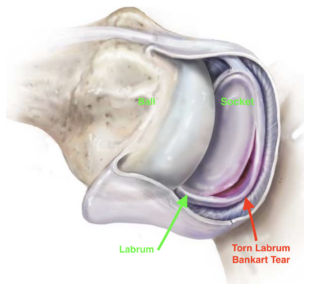
Bankart tear
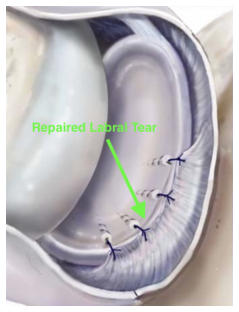
Bankart repair
Recovery
Getting Back to Activity
- Weeks 0-4Sling and protected motion
- Weeks 4-8Motion returns
- Months 2-4Strengthening
- Months 4-5Sport-specific work
- Month 6Contact sport
Recovery Milestones
- Sling: About 4 weeks.
- Desk work: Early weeks.
- Golf: 12 weeks, chipping and putting only at first.
- Tennis: 16 weeks, nothing overhead.
- Throwing: 16 weeks, as an interval program.
- Contact sport: 6 months.
Progress is guided by motion, strength and confidence rather than time alone.
For how this condition is diagnosed and every treatment option, including nonoperative care, read the full Shoulder Instability guide.
Instructions and therapy protocols
Each version of this operation has its own post-op instructions and physical therapy protocol. Bring the protocol to your first therapy visit.
- Anterior Shoulder StabilizationPost-op instructionsPT protocol
- Posterior Shoulder StabilizationPost-op instructionsPT protocol