What Is Shoulder Arthritis?
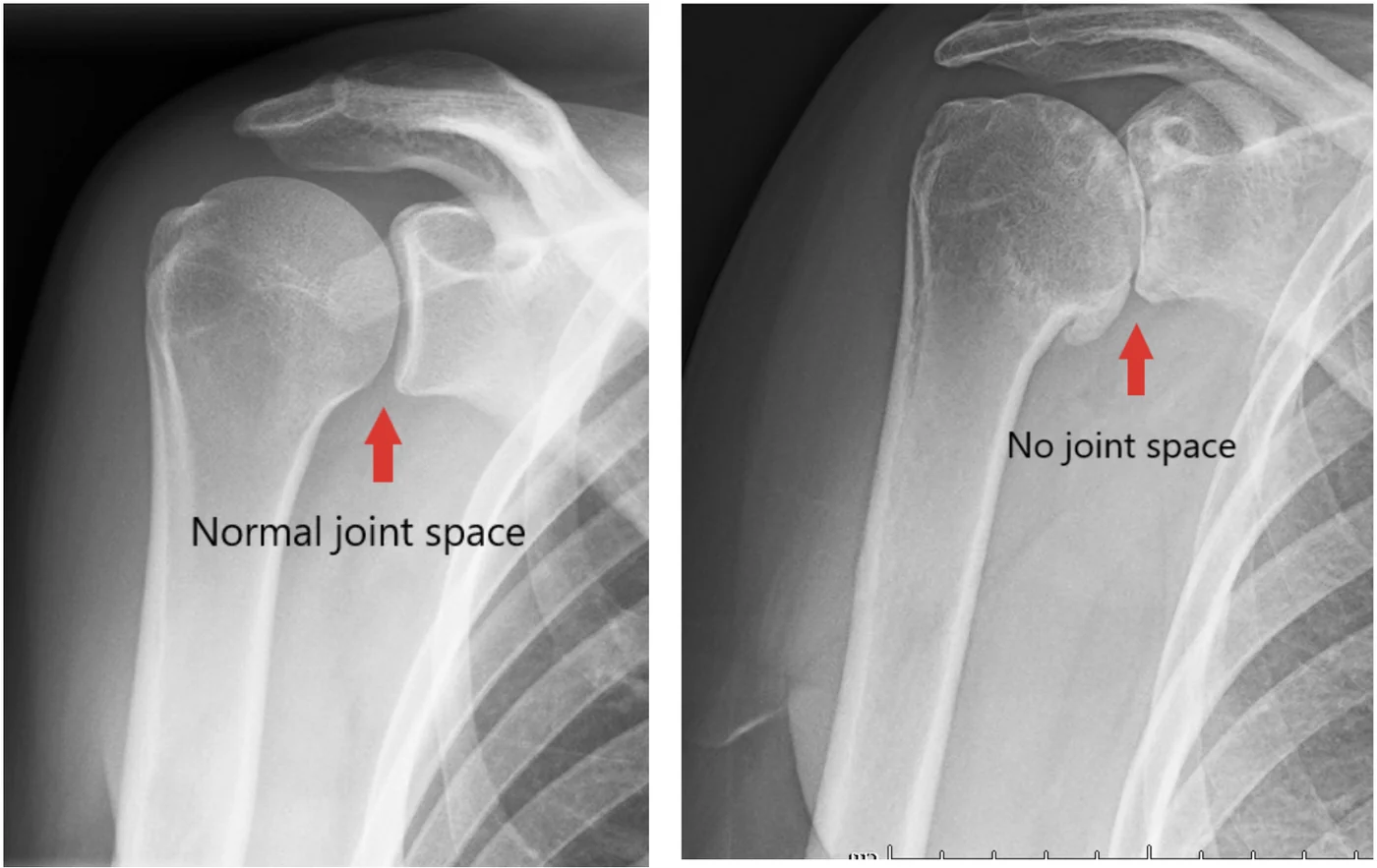
Arthritis means the smooth cartilage that lines a joint has worn away, leaving bone rubbing against bone. The result is inflammation, pain, stiffness, and progressive loss of motion. There is no way to regrow cartilage, so arthritis does not reverse. The goal of treatment is instead to control symptoms and keep you active.
This handout covers arthritis of the glenohumeral joint, the main ball-and-socket joint where the top of the arm bone (humerus) meets the socket of the shoulder blade (glenoid). A separate, smaller joint on top of the shoulder, the acromioclavicular or AC joint, can also develop arthritis and is covered in its own handout.
How Shoulder Arthritis Develops
Most shoulder arthritis develops gradually as cartilage wears with age and use. It can also follow a previous injury such as a fracture or dislocation, develop years after a large rotator cuff tear, or result from an inflammatory condition such as rheumatoid arthritis.
Arthritis of the shoulder is less common than arthritis of the hip or knee, in part because the shoulder is not a weight-bearing joint. When it does occur, it tends to develop slowly, and many patients notice stiffness and loss of rotation before pain becomes the dominant problem.
Common Symptoms
- Deep, aching pain felt inside the shoulder, often worse with activity and movement
- Pain at night that interferes with sleep
- Progressive stiffness, particularly rotating the arm outward
- Grinding or clicking with movement, sometimes loud enough for others to hear
- Increasing difficulty reaching overhead, behind your back, or across your body
How It Is Diagnosed
- A detailed history of your symptoms and prior shoulder injuries
- Physical examination, including where the pain localizes and how much motion you have
- X-rays, which show joint space narrowing, bone spurs, and which joint is involved
- MRI in selected cases, particularly to assess rotator cuff integrity
- CT scan for detailed information about the shape and wear of the socket, used in surgical planning
Types of Glenohumeral Arthritis
Cartilage wears down over time without a clear prior injury. The most common type.
Nonoperative care first. Replacement if advanced.
Arthritis that develops after a large, longstanding rotator cuff tear due to altered shoulder biomechanics.
A reverse replacement is generally required.
Arthritis that develops months to years after a fracture or dislocation.
Depends on the deformity, your age, and the rotator cuff integrity.
Arthritis from rheumatoid or another inflammatory disease.
Medical management, with surgery if it progresses.
The blood supply to the ball is disrupted and the bone collapses. Can follow corticosteroid use, heavy alcohol use, sickle cell disease, or injury among other causes.
Depends on the stage and how much of the joint is involved.
Why the Rotator Cuff is Important
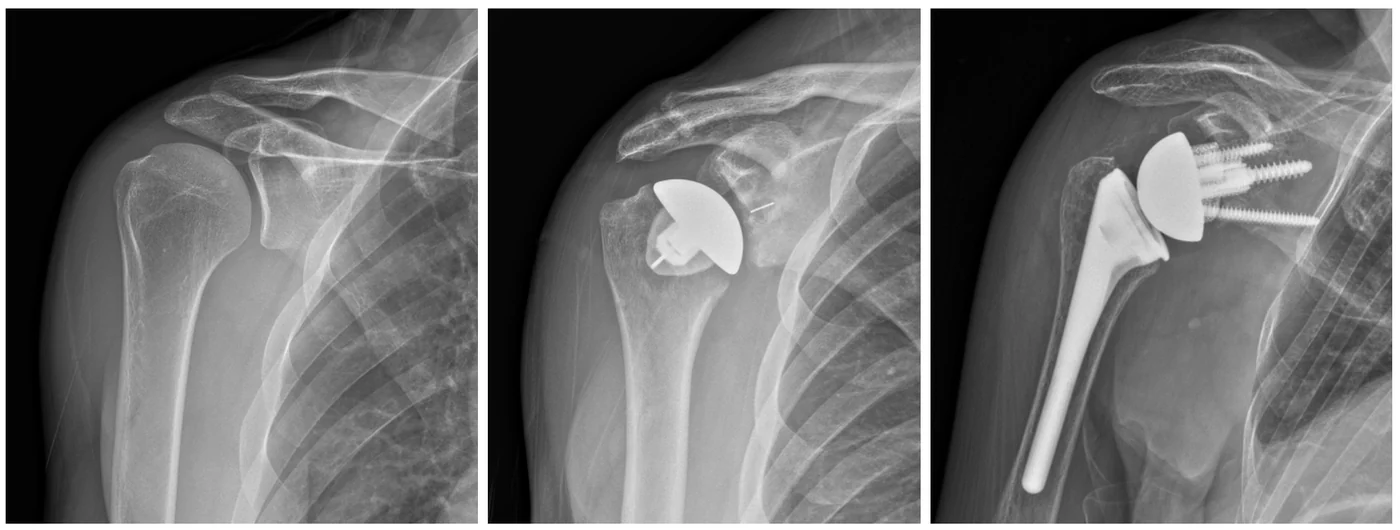
If the shoulder joint needs to be replaced, the condition of your rotator cuff decides which type of replacement is used. An anatomic replacement recreates the normal anatomy with a ball on the arm bone and a socket on the shoulder blade, and it relies on a working rotator cuff to move the shoulder.
When the rotator cuff is torn and nonfunctional or there are severe bone changes on the socket, that design will not work. A reverse replacement switches the ball and socket, which allows the deltoid muscle to lift the arm instead. This is why evaluating the rotator cuff is such an important part of planning.
Your Treatment Options
There is no single right answer for every patient. The decision depends on how advanced the arthritis is, the condition of your rotator cuff, your age and activity level, and how much your symptoms limit you.
Nonoperative Treatment
Activity modification, anti-inflammatory medication, and physical therapy aimed at maintaining the motion and strength you still have. A corticosteroid injection into the joint can provide meaningful relief, though the duration is variable. Research has not supported the use of gel or lubricant injections in the shoulder, though they are commonly used in the knee.
May be appropriate if:
- Your symptoms are manageable and not limiting your daily activities
- Your arthritis is early and you still have reasonable motion
- Injections continue to give you meaningful relief
- You prefer to avoid surgery and the recovery it requires
Nonoperative treatment does not reverse arthritis, but it can control symptoms well for a long time and delay the need for surgery.
Surgical Treatment
For mild arthritis, arthroscopy can sometimes be used to clean out loose cartilage, inflamed tissue, and bone spurs, though relief tends to be temporary and it is not recommended for advanced disease.
For advanced arthritis, shoulder replacement removes the worn surfaces and resurfaces the joint. In an anatomic replacement, a metal ball is placed on the arm bone and a new socket on the shoulder blade, recreating normal anatomy. In a reverse replacement, that arrangement is switched so the deltoid can power the shoulder when the rotator cuff cannot. Both reliably relieve pain, and the choice depends primarily on the condition of your rotator cuff and the shape of your socket.
Often recommended if:
- Pain persists despite injections, medication, and therapy
- Pain is limiting your daily activities
- Stiffness and loss of motion are progressing
- X-rays show advanced arthritis that matches your symptoms
What to Expect After Surgery
Recovery and Return to Activity
- You will wear a sling for several weeks, followed by a gradual program of motion and then strengthening.
- Motion returns over months, and the final result continues to improve for up to a year.
- Pain relief is generally the most reliable result of shoulder replacement. This often occurs earlier than the return of motion and strength.
- Most patients return to everyday activities and low-impact recreation. Heavy overhead lifting and impact activity are usually discouraged long term.
- Rehabilitation is the single most important factor you control!
Risks to Understand
- Shoulder replacements have an excellent track record but can wear over time. Components can occasionally loosen, and revision surgery is more complex than the first operation.
- Younger and more active patients place greater demand on a replacement, which is part of why timing matters.
- Other risks include infection, nerve irritation, stiffness, fracture, and problems related to anesthesia. This will be discussed in more detail prior to surgery.
- Smoking and nicotine use and consistent marijuana use are associated with poorer healing.
Selected Background Sources
The guidance in this handout reflects current peer-reviewed orthopedic literature and professional society recommendations. Selected sources include:
- American Academy of Orthopaedic Surgeons. Clinical Practice Guideline: Glenohumeral Joint Osteoarthritis. 2024.
- Piper C, Neviaser A. Survivorship of anatomic total shoulder arthroplasty. J Am Acad Orthop Surg. 2022.
- Carter MJ, et al. Impact of total shoulder arthroplasty on quality of life: systematic review and meta-analysis. J Bone Joint Surg Am. 2012.
- Kirsch JM, et al. Anatomic versus reverse shoulder arthroplasty for glenohumeral osteoarthritis: matched analysis. J Bone Joint Surg Am. 2022.
- Sharareh B, et al. Minimum 10-year follow-up of anatomic total shoulder arthroplasty. J Shoulder Elbow Surg. 2024.
- Smith KL, et al. Patient satisfaction after reverse shoulder arthroplasty: systematic review. J Shoulder Elbow Surg. 2024.
This handout is for education and does not replace the discussion with your surgeon. Ask Dr. Tummala about anything that applies to your specific shoulder.
Handouts for this condition
- Condition guideThe printable version of this pageOpen PDF
If you are having surgery
You will receive a guide to your specific operation at your visit. Read what to expect from Anatomic Shoulder Replacement and Reverse Shoulder Replacement, including the instructions and therapy protocols for after surgery. The Preparing for Surgery Booklet is on the Having surgery page.