Surgery is considered when it is the right choice for you. Before your operation you will receive a Preparing for Surgery booklet and a detailed guide related to your specific procedure.
Overview
A normal shoulder works as a ball on the arm bone moving in a shallow socket, with the rotator cuff holding it centered and powering motion. When the rotator cuff is nonfunctional or there is significant deformity of the joint, a standard replacement will not work well because there is nothing left to control the ball. A reverse replacement switches the two: a metal ball is fixed to the socket and a plastic socket to the arm bone. This lets the deltoid, the large muscle over the outside of the shoulder, lift the arm on its own without needing the rotator cuff. Some patients, particularly older patients, also choose a reverse for a more durable result than an anatomic replacement.
- The goal of this surgery is to relieve pain and restore the ability to raise your arm. Most patients gain roughly 50 to 60 degrees of forward elevation and their pain drops substantially.
- Reaching behind your back is the least predictable.
- The implant is durable but not permanent. Around 93 to 96% are still in place at 10 years. Durability may not be as robust in younger patients or more active patients.
Technique
- Approach is through an incision at the front of the shoulder.
- The worn joint surfaces are removed. A metal baseplate is fixed to the socket with screws and a metal ball is attached to it.
- The top of the arm bone is prepared and a stem with a plastic socket is placed into it.
- The muscle at the front of the shoulder (subscapularis) is repaired at the end when possible.
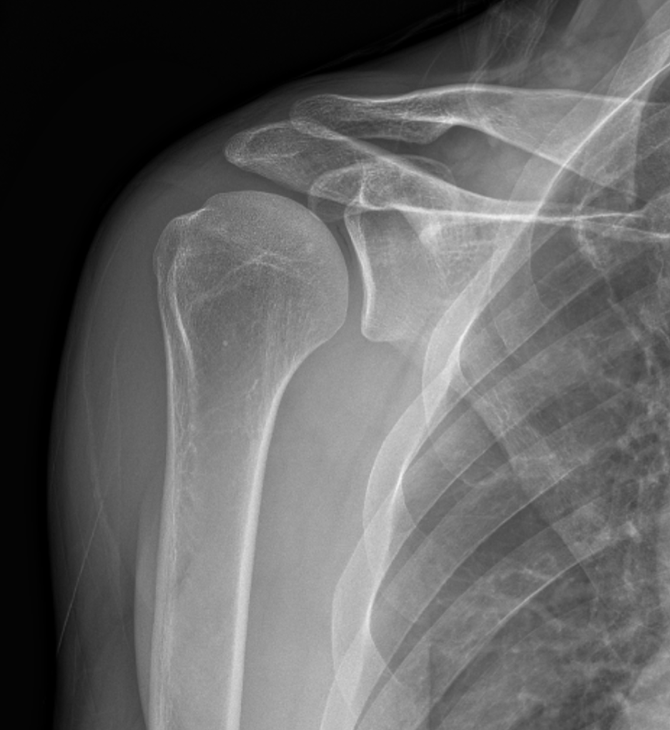
Normal shoulder
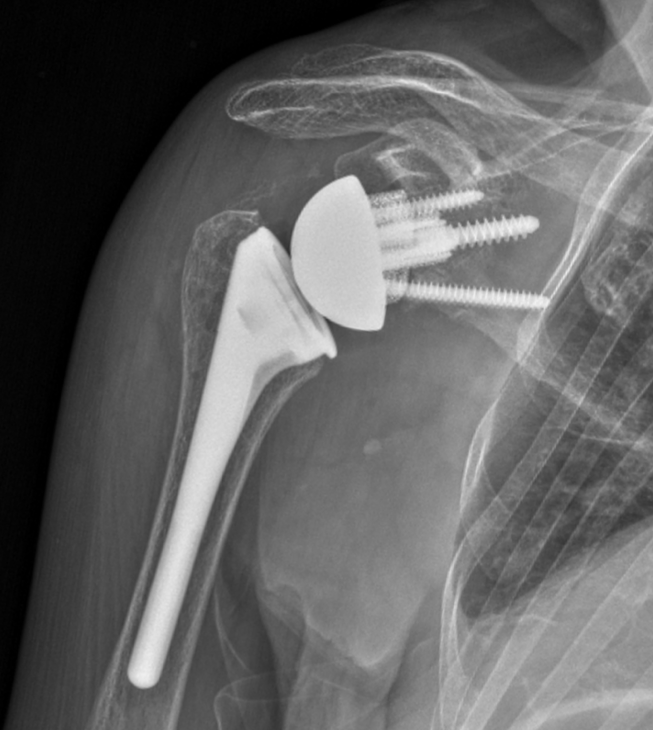
Reverse replacement
Recovery
Getting Back to Activity
- Weeks 0-6Sling and home exercises
- Week 6Sling off, therapy begins
- Weeks 6-12Motion to 90°, light bands
- Week 12Strengthening advances
- Months 3-12Motion to full, strength builds
Recovery Milestones
- Desk work: About 4 weeks.
- Daily activities: Around 3 months.
- Swimming: 4 to 6 months.
- Golf: 4 months, chipping and putting; full swing at 6 months.
- Tennis: 6 months.
- Continued improvement: Around 12 months.
Progress is guided by motion, strength and comfort rather than time alone.
For how this condition is diagnosed and every treatment option, including nonoperative care, read the full Shoulder Arthritis guide.
Instructions and therapy protocols
Each version of this operation has its own post-op instructions and physical therapy protocol. Bring the protocol to your first therapy visit.
- Reverse Shoulder Replacement (Standard)Post-op instructionsPT protocol
- Reverse Shoulder Replacement (Accelerated)Post-op instructionsPT protocol