What Is the Knee Extensor Mechanism?
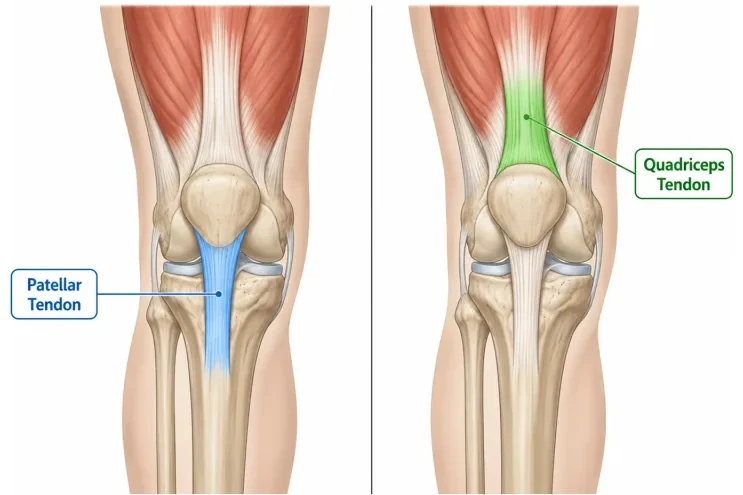
The quadriceps tendon connects the large thigh muscle (quadriceps) to the top of the kneecap (patella). The patellar tendon connects the bottom of the kneecap to the shinbone. Together with the kneecap, they form the extensor mechanism, which lets you straighten your knee, climb stairs and stand up from a chair.
A tear can be partial or complete. When a tendon tears all the way through, you usually cannot straighten your knee or lift your leg straight off the bed.
How These Tears Happen
Both tears usually happen in a similar fashion. The thigh muscle contracts hard while the knee is bent and bearing weight. This can happen with a stumble or fall, landing from a jump or catching yourself on a step. A tendon that was already weakened can tear with less force than typical also.
Quadriceps tendon tears are more common and usually happen after age 40. Patellar tendon tears tend to happen in younger, active people. Both are more common in men.
Some health conditions and medicines can weaken tendons. These include kidney disease, diabetes, obesity, inflammatory arthritis and gout, long-standing tendon pain (jumper's knee), steroid pills or injections and anabolic steroids. A type of antibiotic called a fluoroquinolone (such as ciprofloxacin or levofloxacin) also carries a warning for tendon tears.
Common Symptoms
- Sudden pain at the front of the knee often with a pop
- Swelling and bruising around the kneecap
- Trouble straightening the knee or lifting the leg straight
- A palpable gap just above or below the kneecap
- The knee buckles or gives way when you try to walk
How It Is Diagnosed
- A history of how the injury happened and a physical examination. We typically evaluate whether you can lift your leg straight and hold it straight in the air.
- X-rays show where the kneecap sits. It rides lower after a quadriceps tendon tear and higher after a patellar tendon tear than normal.
- An ultrasound or MRI can confirm the tear and show whether it is partial or complete
- MRI also checks for other injuries inside the knee
Types of Tendon Tears
Your Treatment Options
Most complete tears need surgery. Repair within 2-3 weeks tends to give the best results. Some partial tears can be treated without surgery.
Nonoperative Treatment
A partial tear where you can still straighten the knee and lift the leg may be treated without surgery. A brace locked straight is usually worn for about 4 to 6 weeks, followed by physical therapy to restore motion and strength.
Partial tears can still worsen so close follow-up is important.
May be appropriate if:
- The tear is partial on ultrasound or MRI
- You can lift your leg straight without the knee bending
- Your activity level or health makes surgery less appealing
Surgical Treatment
Surgery reattaches the torn tendon to the kneecap with strong sutures. These are secured through small tunnels in the kneecap or with suture anchors placed in the bone. The repair may be reinforced, particularly for larger or older tears.
Earlier repair is easier and tends to recover more fully. Tears that are weeks or months old may need a graft or a lengthening procedure.
Often recommended if:
- The tear is complete and you cannot straighten your knee
- A partial tear is getting worse
- A partial tear is in a very active person or athlete
Recovery and Return to Sport
Recovery and Return to Activity
After surgery:
- A brace locked straight is worn for walking and sleeping typically for the first 8 weeks or so
- You can usually put weight on the leg in the brace right away, using crutches until you are comfortable
- Bending is increased in steps as you progress
- Desk work is often possible within 1 to 2 weeks
- Running usually starts around 4 to 5 months, beginning with pool running
- Return to sport is around six months after surgery, once you meet strength and testing goals
- Physical or manual work often takes 4 to 6 months or more
- Most people return to work and to sport. Returning to the same level of sport is less certain.
Risks to Understand
- Some lasting thigh muscle weakness is common, even when the leg feels strong. This makes rehabilitation very important.
- A small loss of full straightening or bending can persist
- Re-tear is uncommon but possible
- Other risks include infection or wound problems (more common with diabetes), stiffness and blood clots
If your tear was linked to a health condition, your other knee may also be at risk. Managing diabetes, kidney disease and weight, not smoking and reminding your doctors about your tendon injury before taking a fluoroquinolone can help protect it.
Selected Background Sources
The guidance in this handout reflects current peer-reviewed orthopedic literature and professional society recommendations. Selected sources include:
- American Academy of Orthopaedic Surgeons. Quadriceps Tendon Tear and Patellar Tendon Tear. OrthoInfo.
- Garner MR, et al. Extensor mechanism injuries of the knee: demographic characteristics and comorbidities from a review of 726 patient records. J Bone Joint Surg Am. 2015.
- Ilan DI, et al. Quadriceps tendon rupture. J Am Acad Orthop Surg. 2003.
- Matava MJ. Patellar tendon ruptures. J Am Acad Orthop Surg. 1996.
- Arnold EP, et al. Acute quadriceps tendon rupture: presentation, diagnosis, and management. JBJS Rev. 2022.
- Ciriello V, et al. Clinical outcomes after repair of quadriceps tendon rupture: a systematic review. Injury. 2012.
- O'Dowd JA, et al. Operative treatment of acute patellar tendon ruptures. Am J Sports Med. 2020.
- VanDerwerker NB, et al. Transosseous tunnel suture fixation results in similar rerupture rates and patient-reported outcome measures compared to suture anchors for primary quadriceps tendon repair: a systematic review. Arthroscopy. 2025.
- West JL, et al. Early motion after quadriceps and patellar tendon repairs. Am J Sports Med. 2008.
- Langenhan R, et al. Postoperative functional rehabilitation after repair of quadriceps tendon ruptures: a comparison of two different protocols. Knee Surg Sports Traumatol Arthrosc. 2012.
- Haskel JD, et al. High rates of return to play and work follow knee extensor tendon ruptures but low rate of return to pre-injury level of play. Knee Surg Sports Traumatol Arthrosc. 2021.
- Beranger JS, et al. Return to sport after early surgical repair of acute patellar tendon ruptures. Orthop Traumatol Surg Res. 2020.
- Persson R, Jick S. Clinical implications of the association between fluoroquinolones and tendon rupture: the magnitude of the effect with and without corticosteroids. Br J Clin Pharmacol. 2019.
This handout is for education and does not replace the discussion with your surgeon. Ask Dr. Tummala about anything that applies to your specific knee.
Handouts for this condition
- Condition guideThe printable version of this pageOpen PDF
If you are having surgery
You will receive a guide to your specific operation at your visit. Read what to expect from Tendon Repair, including the instructions and therapy protocols for after surgery. The Preparing for Surgery Booklet is on the Having surgery page.