What Is the Meniscus?
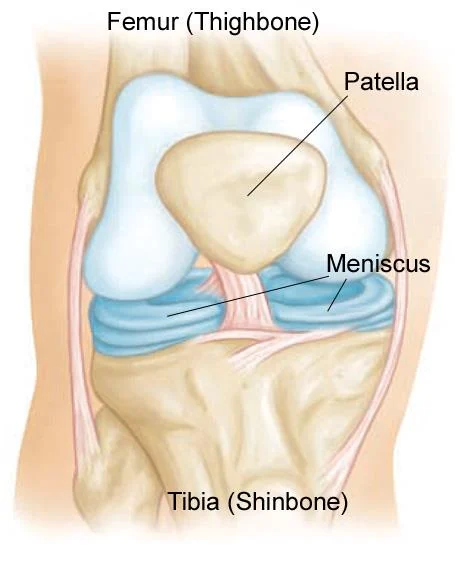
Each knee has two menisci or wedge-shaped shock absorbers that sit between the thighbone (femur) and the shinbone (tibia). They function to spread load across the joint and help keep the knee stable.
Whether a tear can heal depends largely on where it sits. The outer third of the meniscus has a good blood supply, so tears there can often heal or be repaired with stitches. The inner two-thirds has little blood supply, so tears there generally cannot heal and if they are causing symptoms, the damaged portion is usually trimmed away gently instead.
How Meniscus Tears Happen
Meniscus tears occur in two general patterns. Acute tears usually happen during sport, from twisting, pivoting, or cutting with the foot planted. These often occur alongside other knee injuries, particularly ACL tears. Degenerative tears develop as the meniscus wears down with age and changes in composition. These can happen with something as ordinary as twisting while getting up from a chair or going down stairs.
Meniscus tears become more common with age as the tissue becomes less resilient, and many are not symptomatic. Many people over 40 have a degenerative tear without any symptoms at all, only found incidentally on imaging. Finding a tear on an MRI does not automatically mean it is the cause of your pain or that it needs surgery, particularly when arthritis is also present.
Common Symptoms
- A pop or acute pain at the time of injury, though many people can still walk afterward
- Pain along the joint line, often worse with twisting or squatting
- Swelling and stiffness that build over the first two to three days
- Knee catching, clicking through range of motion or locking so it will not fully straighten
- A sense that the knee is giving way
How It Is Diagnosed
- A detailed history of your symptoms and any injury
- Physical examination, including tenderness along the joint line and specific twisting tests
- X-rays, which do not show the meniscus but reveal arthritis, alignment, and other causes of knee pain
- MRI to help confirm the tear and show its pattern, size, and location, along with any associated injuries
Types of Meniscus Tears
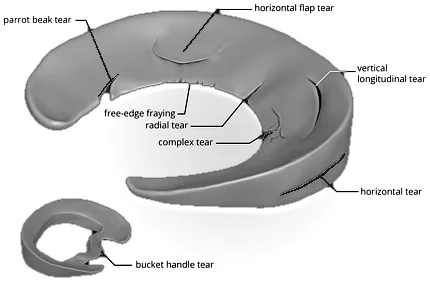
A tear in the outer part of the meniscus, where blood supply is good.
Often repairable with stitches
A tear in the inner portion where there is little blood supply to allow healing.
Usually trimmed if it is causing symptoms and has failed conservative care
A large tear where a fragment displaces into the joint and can lock the knee.
Often needs prompt surgery and can be repairable
A tear where the meniscus attaches to the bone. This type of tear can make the meniscus essentially non-functional.
Repair is often recommended to preserve longer term knee function
Wear-related tearing, frequently alongside early arthritis.
Usually managed without surgery first
Why Preserving Your Meniscus Matters
The meniscus spreads force across the knee and protects the smooth cartilage lining the joint. When meniscus tissue is removed excessively, that force concentrates on a smaller area. Research has shown a higher rate of arthritis progression over the following years compared with knees where the meniscus was preserved.
For this reason, the goal is to save meniscus tissue whenever it is reasonable to do so. However, not every tear can be repaired and not every tear needs surgery. It depends on where the tear sits, its pattern, and the quality of the tissue. But when a tear is repairable, repair is generally preferred over trimming, particularly in younger and more active patients even though the rehabilitation process is longer.
Your Treatment Options
There is no single right answer for every patient. The decision depends on the pattern and location of your tear, your symptoms, your age and activity level, the condition of the rest of the knee, and your goals.
Nonoperative Treatment
Activity modification, ice, and anti-inflammatory medication early on, followed by structured physical therapy to restore motion and strengthen the muscles around the knee. A corticosteroid or related injection may help with pain and swelling in some patients.
May be appropriate if:
- Your tear is degenerative rather than from a specific injury
- Your knee is not locking or catching mechanically
- Arthritis is also present, in which case surgery is less likely to help the pain
- You prefer to avoid surgery and the recovery it requires
For degenerative tears, particularly with arthritis present, strong evidence supports trying physical therapy first. Many patients improve enough that surgery is never needed.
Surgical Treatment
Surgery is done arthroscopically through small incisions. There are two main options. A repair uses stitches to hold the torn edges together so they can heal, preserving the meniscus. A partial meniscectomy trims away the damaged portion that cannot heal. The decision is often confirmed during surgery once the tear can be seen directly. In patients who have already lost most of a meniscus from prior surgery or injury, transplantation of donor tissue may be considered as well.
Often recommended if:
- Your knee locks, catches, or you cannot fully straighten it
- You have an acute tear from a specific injury, especially in a repairable location
- The tear occurred alongside an ACL injury being reconstructed
- Symptoms persist despite a genuine course of therapy
What to Expect After Surgery
Recovery Depends on What Was Done
- After a partial meniscectomy, recovery is relatively quick. Weight bearing and motion usually begin right away, with return to most activities over the next few weeks.
- After a repair, recovery is considerably longer. The meniscus must heal, which often means a brace, restricted weight bearing, and limited bending for the first several weeks with a slow progression in the following months.
- Return to sport is typically a few weeks after meniscectomy and around six months after a repair.
- The longer recovery after repair is the tradeoff for preserving meniscus tissue and protecting the knee longer term.
- Rehabilitation is the single most important factor you control!
Risks to Understand
- A repair can fail to heal and a second operation is sometimes needed. Failure is more likely with certain tear patterns and locations.
- Removing a critical amount of meniscus tissue is associated with a higher rate of arthritis progression over the following years than preserving it.
- Knee stiffness is common early on and usually improves with therapy.
- Other risks include infection, blood clots, nerve irritation, and problems related to anesthesia. This will be discussed in more detail prior to surgery.
- Smoking and nicotine use and consistent marijuana use are associated with poorer healing.
Selected Background Sources
The guidance in this handout reflects current peer-reviewed orthopedic literature and professional society recommendations. Selected sources include:
- American Academy of Orthopaedic Surgeons. Clinical Practice Guideline: Acute Isolated Meniscal Pathology. 2024.
- Schweizer C, et al. Meniscal repair outcomes: meta-analysis on failure rate. Am J Sports Med. 2024.
- Nepple JJ, et al. Meniscal repair outcomes at greater than 5 years: systematic review. J Bone Joint Surg Am. 2022.
- Migliorini F, et al. Meniscectomy associated with higher osteoarthritis rate versus repair: meta-analysis. Knee Surg Sports Traumatol Arthrosc. 2023.
- Persson F, et al. Risk of symptomatic knee osteoarthritis after repair versus meniscectomy. Osteoarthritis Cartilage. 2018.
- Longo UG, et al. Knee osteoarthritis after partial meniscectomy. J Knee Surg. 2019.
- van der List JP, et al. Early meniscal repair leads to higher success than delayed repair. Am J Sports Med. 2025.
This handout is for education and does not replace the discussion with your surgeon. Ask Dr. Tummala about anything that applies to your specific knee.
Handouts for this condition
- Condition guideThe printable version of this pageOpen PDF
If you are having surgery
You will receive a guide to your specific operation at your visit. Read what to expect from Meniscus Surgery, including the instructions and therapy protocols for after surgery. The Preparing for Surgery Booklet is on the Having surgery page.