What Is the ACL?
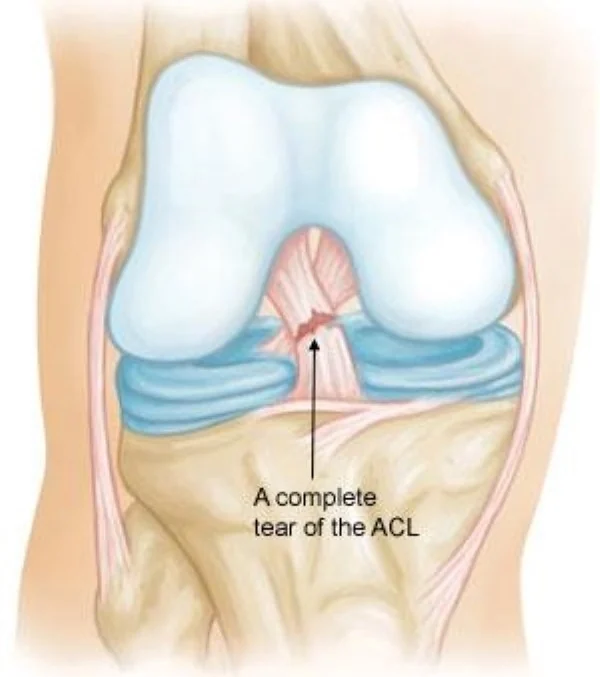
The anterior cruciate ligament (ACL) is one of the main stabilizing ligaments inside your knee. It connects your thighbone (femur) to your shinbone (tibia) and acts as the primary restraint that keeps your knee from sliding forward and twisting out of position.
When the ACL tears, it does not heal back together on its own. The ligament sits inside the joint and is bathed in joint fluid with a limited blood supply. Though certain tear patterns may be amenable to repair, the research on this is ongoing. The ACL is generally reconstructed with a new tissue graft to stabilize the knee.
How ACL Injuries Happen
Most ACL tears happen without direct contact to the knee. They typically occur during twisting or pivoting, sudden slowing down or changing direction, or landing awkwardly from a jump. Contact injuries, such as a blow to the knee or leg, also occur but are less common.
(less common)
ACL injuries can happen to anyone. Risk varies considerably depending on age, sport, the level of play, and individual factors. In general, younger athletes are more likely to get injured and females are injured more often than males.
Common Symptoms
- A “pop” or tearing sensation at the time of injury
- Rapid swelling within the first several hours
- Pain and difficulty bearing weight
- A feeling that the knee is loose, unstable, or may give way
- Loss of full motion, especially straightening
- Locking or catching, which may indicate an associated meniscus injury
How It Is Diagnosed
- A detailed history of how the injury occurred
- Physical examination, including specific ligament stability tests
- X-rays to check for fracture and assess alignment
- MRI to confirm the ACL tear and identify injuries to the meniscus, cartilage, or other ligaments
Grades of ACL Injury
Your Treatment Options
There is no single right answer for every patient. The decision depends on your activity goals, the degree of instability you feel, your age, and whether other structures in the knee are injured.
Nonoperative Treatment
Structured physical therapy focused on strength, control, and stability. May include activity modification and bracing.
May be appropriate if:
- You do not participate in cutting or pivoting sports
- Your knee feels stable during daily activity
- You are willing to modify activities
Surgical Reconstruction
The torn ACL is replaced with a tissue graft, usually taken from your own body, but sometimes from cadaver tissue. The choice of graft is individualized and based on your age, sport, anatomy, and goals. Any associated alignment, meniscus or cartilage injury may be addressed at the same time. In some patients at higher risk of reinjury, an additional procedure on the outside of the knee (either a lateral extra-articular tenodesis or an anterolateral ligament reconstruction) may be added to further protect the reconstruction.
Often recommended if:
- You want to return to cutting or pivoting sports
- Your knee gives way during normal activity
- You have an associated meniscus or cartilage injury
- You are young and highly active
Why Timing Matters
A knee without a functioning ACL may continue to shift or give way during activity. Each of those episodes carries a risk of injuring other structures in the knee such as the meniscus and the cartilage that lines the joint.
Research has generally shown that the longer a knee goes without a stable ACL, the more likely it is that additional damage will be found at the time of surgery. Because meniscus and cartilage injuries can affect the long-term health of the knee, we usually do not recommend waiting indefinitely once surgery has been chosen.
What to Expect After Reconstruction
Returning to Sport
- Most patients are able to return to sport, though not everyone returns to the same level of play they had before the injury.
- Recovery generally takes about nine to twelve months.
- Returning too early is associated with a higher risk of reinjury. Readiness is judged by strength and functional testing, not by the time since surgery alone.
- Rehabilitation is the single most important factor you control!
Risks to Understand
- The graft can re-tear. This is more common in younger patients returning to cutting and pivoting sports.
- The opposite knee is also at increased risk of injury over time, particularly in younger and female patients. We recommend ongoing preventative exercises.
- Other risks include knee stiffness, infection, blood clots, numbness near the incision, and discomfort at the site where the graft was taken. This will be discussed in more detail prior to surgery.
- Smoking, nicotine, and consistent marijuana use are associated with poorer healing and outcomes.
Selected Background Sources
The guidance in this handout reflects current peer-reviewed orthopedic literature and professional society recommendations. Selected sources include:
- Chia L, et al. Non-contact ACL injury epidemiology in team-ball sports. Sports Med. 2022.
- Montalvo AM, et al. ACL injury risk in sport: incidence by sex and sport classification. J Athl Train. 2019.
- Prodromidis AD, et al. Timing of ACL reconstruction and chondral injuries. Am J Sports Med. 2021.
- Swedish National Knee Ligament Register analyses. KSSTA. 2017, 2024.
- Connors JP, et al. Return to sport and graft failure after ACL reconstruction. Am J Sports Med. 2025.
- Filbay SR, et al. Return to sport after ACL reconstruction versus rehabilitation. Sports Med. 2025.
- American Academy of Orthopaedic Surgeons. Clinical Practice Guideline: Management of ACL Injuries.
This handout is for education and does not replace the discussion with your surgeon. Ask Dr. Tummala about anything that applies to your specific knee.
Handouts for this condition
- Condition guideThe printable version of this pageOpen PDF
If you are having surgery
You will receive a guide to your specific operation at your visit. Read what to expect from ACL Reconstruction and MCL Reconstruction, including the instructions and therapy protocols for after surgery. The Preparing for Surgery Booklet is on the Having surgery page.