What Is the PCL?
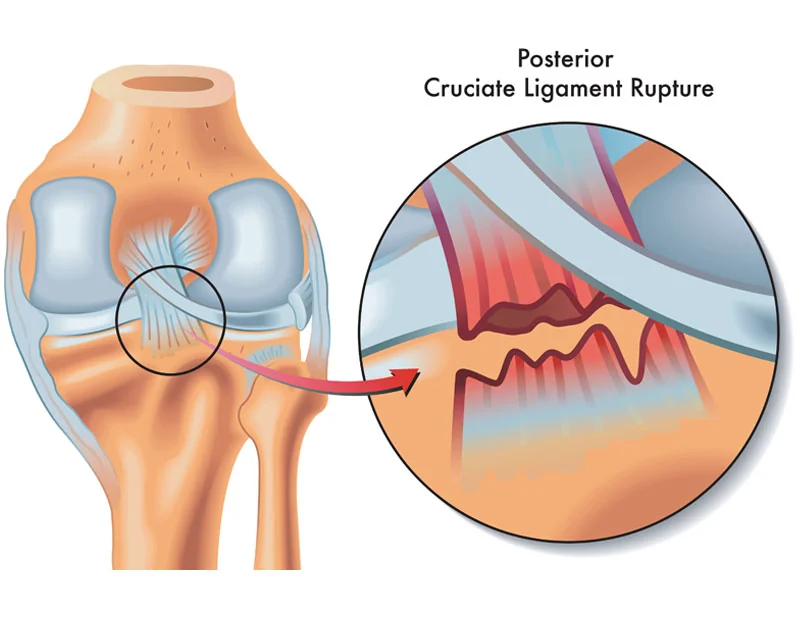
The posterior cruciate ligament (PCL) sits deep inside the knee, running from the back of the shinbone (tibia) up to the thighbone (femur). It is the largest and strongest ligament in the knee. Its main job is to stop the tibia from sliding backward underneath the femur, particularly when the knee is bent. Because the PCL is so strong, it takes considerable force to injure it. As a result, an isolated PCL tear is relatively uncommon.
How PCL Injuries Happen
The classic mechanism is a direct blow to the front of the shinbone while the knee is bent. This can happen when a bent knee strikes a dashboard in a motor vehicle accident, when an athlete falls directly onto a bent knee or from a hard tackle. Hyperextension of the knee can also injure the PCL along with other ligaments.
PCL injuries behave differently from ACL injuries in an important way. Many isolated PCL injuries can be managed successfully without surgery and the ligament has some capacity to heal. When the PCL is injured together with other ligaments in the knee, it may change the need for surgical intervention.
Common Symptoms
- Pain and swelling after the injury
- A vague sense of instability or discomfort rather than the knee clearly giving way
- Difficulty and discomfort going down stairs or slopes
- Aching at the front of the knee or behind the kneecap that develops over time
- Some patients may notice relatively little at first with the symptoms developing over time
How It Is Diagnosed
- A detailed history of how the injury occurred
- Physical examination including specific tests for backward movement of the tibia along with a careful assessment of the other ligaments in the knee
- X-rays to look for fractures or a bony fragment that may have been pulled off with the ligament
- MRI to confirm the PCL injury and identify injuries to other soft tissue structures such as ligaments, the menisci, or cartilage.
- Kneeling stress X-rays may be used to assist in diagnosis.
Grades of PCL Injury
Your Treatment Options
The decision depends most on whether the PCL was injured on its own or together with other ligaments, how much laxity is present, and your activity demands.
Nonoperative Treatment
Most isolated PCL injuries are treated without surgery. A specialized PCL brace is recommended for about the first three months to help hold the tibia forward while the ligament heals. Rehabilitation emphasizes quadriceps strengthening because these muscles pull the tibia forward and directly counteract the motion the PCL normally resists. Hamstring exercises are limited early on.
May be appropriate if:
- Your PCL was injured on its own without other ligament involvement
- The laxity is mild to moderate on examination
- Your knee feels stable during daily activity
- You prefer to avoid surgery and the recovery it requires
Many patients with isolated PCL injuries return to full activity without surgery. Quadriceps strength is a very important factor and rehabilitation is often longer than patients expect.
Surgical Treatment
PCL reconstruction uses a tendon graft to recreate the ligament and maintain a more anatomic position of the joint. When a fragment of bone has been pulled off with the ligament, that piece can sometimes be repaired directly rather than reconstructed. Other injured ligaments may be addressed at the same operation.
In patients with longstanding PCL deficiency and malalignment, an osteotomy (cutting the bone) to change the alignment of the leg is sometimes performed alongside or before reconstruction to protect the reconstruction.
Often recommended if:
- The PCL is torn together with other ligaments
- There is a bony fragment pulled off with the ligament that can be repaired
- Significant laxity persists and the knee feels unstable despite rehabilitation
- Symptoms limit your sport, work, or daily activities
Recovery and Return to Sport
Recovery and Return to Activity
Without surgery:
- Most isolated PCL injuries treated without surgery return to full sport in about four to five months.
- Running usually begins around three to four months once motion and quadriceps strength have returned.
After surgery:
- Recovery after PCL surgery takes months and requires dedicated effort in rehabilitation. A specialized brace is used for an extended period to protect the graft.
- Weight bearing and motion are advanced carefully
- Return to sport is typically nine to twelve months after surgery
- Quadriceps strength is a key measure of readiness and is critical to work on
- Rehabilitation is the single most important factor you control!
Risks to Understand
- Some residual laxity is common after PCL reconstruction but is usually not clinically relevant.
- A PCL-deficient knee places extra load on the kneecap and the inner compartment. This can lead to arthritis in those areas over time.
- Other risks include infection, blood clots, and problems related to anesthesia. This will be discussed in more detail prior to surgery.
Selected Background Sources
The guidance in this handout reflects current peer-reviewed orthopedic literature and professional society recommendations. Selected sources include:
- American Academy of Orthopaedic Surgeons. Posterior Cruciate Ligament Injuries. OrthoInfo.
- Pache S, et al. Posterior cruciate ligament: current concepts review. Arch Bone Jt Surg. 2018.
- Pierce CM, et al. Posterior cruciate ligament tears: functional and postoperative rehabilitation. Knee Surg Sports Traumatol Arthrosc. 2013.
- Schulz MS, et al. Epidemiology of posterior cruciate ligament injuries. Arch Orthop Trauma Surg. 2003.
- Jacobi M, et al. Nonoperative treatment of acute isolated PCL injury with dynamic anterior drawer brace. Am J Sports Med. 2010.
- Agolley D, et al. Successful return to sports in athletes following non-operative management of acute isolated posterior cruciate ligament injuries. Bone Joint J. 2017.
- Chahla J, et al. Posterior cruciate ligament. Arthroscopy. 2020.
- Kennedy NI, et al. Posterior cruciate ligament graft fixation angles: biomechanical evaluation. Am J Sports Med. 2014.
This handout is for education and does not replace the discussion with your surgeon. Ask Dr. Tummala about anything that applies to your specific knee.
Handouts for this condition
- Condition guideThe printable version of this pageOpen PDF
- Physical therapy protocolNonoperative plan to bring to your therapistOpen PDF
If you are having surgery
You will receive a guide to your specific operation at your visit. Read what to expect from PCL and Posterolateral Corner Reconstruction, including the instructions and therapy protocols for after surgery. The Preparing for Surgery Booklet is on the Having surgery page.