What Is the MCL?
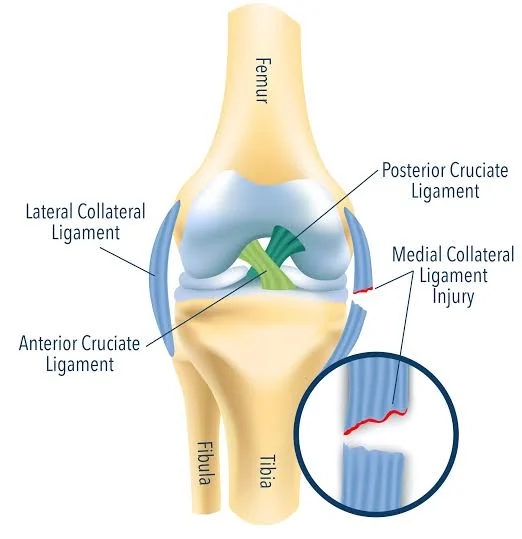
The medial collateral ligament (MCL) is a strong stabilizing structure on the inner side of the knee. It connects the thigh bone (femur) to the shinbone (tibia) and keeps the knee from bending inward.
Most MCL injuries heal without surgery with a few notable exceptions. The MCL has a good blood supply which gives it a strong ability to heal.
How MCL Injuries Happen
Most MCL injuries come from a blow to the outside of the knee while the foot is planted. This is common in football, rugby, hockey and soccer. An MCL injury can also happen without contact from a twist or awkward landing such as in skiing.
Where the tear is matters. Most MCL tears are near the thigh bone (femur) and these have a higher chance of healing by themselves. Tears near the shinbone heal less reliably.
Common Symptoms
- Pain and tenderness on the inner side of the knee
- Swelling along the inner knee
- Some people feel a pop at the time of injury
- Stiffness or trouble bending the knee
- A feeling that the knee wants to give way inward with more severe injuries
How It Is Diagnosed
- A history of how the injury happened and a physical examination. We typically check the ligament integrity by gently pushing it inward with the knee bent and straight.
- X-rays may be taken to check for a fracture
- An MRI is typically not needed for most mild or moderate injuries, but may be considered.
Grades of MCL Injury
Your Treatment Options
Most MCL injuries are treated without surgery. The goal is to protect the ligament while keeping the knee moving and maintain strength.
Nonoperative Treatment
A hinged knee brace may be used to support the inner knee while allowing it to bend and straighten. It is usually worn for several weeks for grade 2 and 3 injuries.
You can usually put weight on the leg as comfort allows, sometimes with crutches at first. Moving the knee early helps the ligament heal and lowers the chance of stiffness.
Physical therapy restores motion, strength and balance and then progresses to running and sport-specific drills.
May be appropriate if:
- The injury is grade 1, 2 or most grade 3 injuries
- The tear is near the thigh bone
- The knee is stable when tested
A short course of an anti-inflammatory medication or acetaminophen can help with pain and swelling in the first couple of weeks.
Surgical Treatment
Surgery either repairs the ligament or rebuilds it with a graft (reconstruction). Both can give good results.
Surgery is considered for select cases, usually after a trial of bracing and rehabilitation.
Often considered if:
- The knee stays loose and unstable after bracing and rehabilitation is tried
- The torn end of the ligament has flipped out of place
- The MCL is torn along with other ligaments
Recovery and Return to Sport
Recovery and Return to Activity
Without surgery:
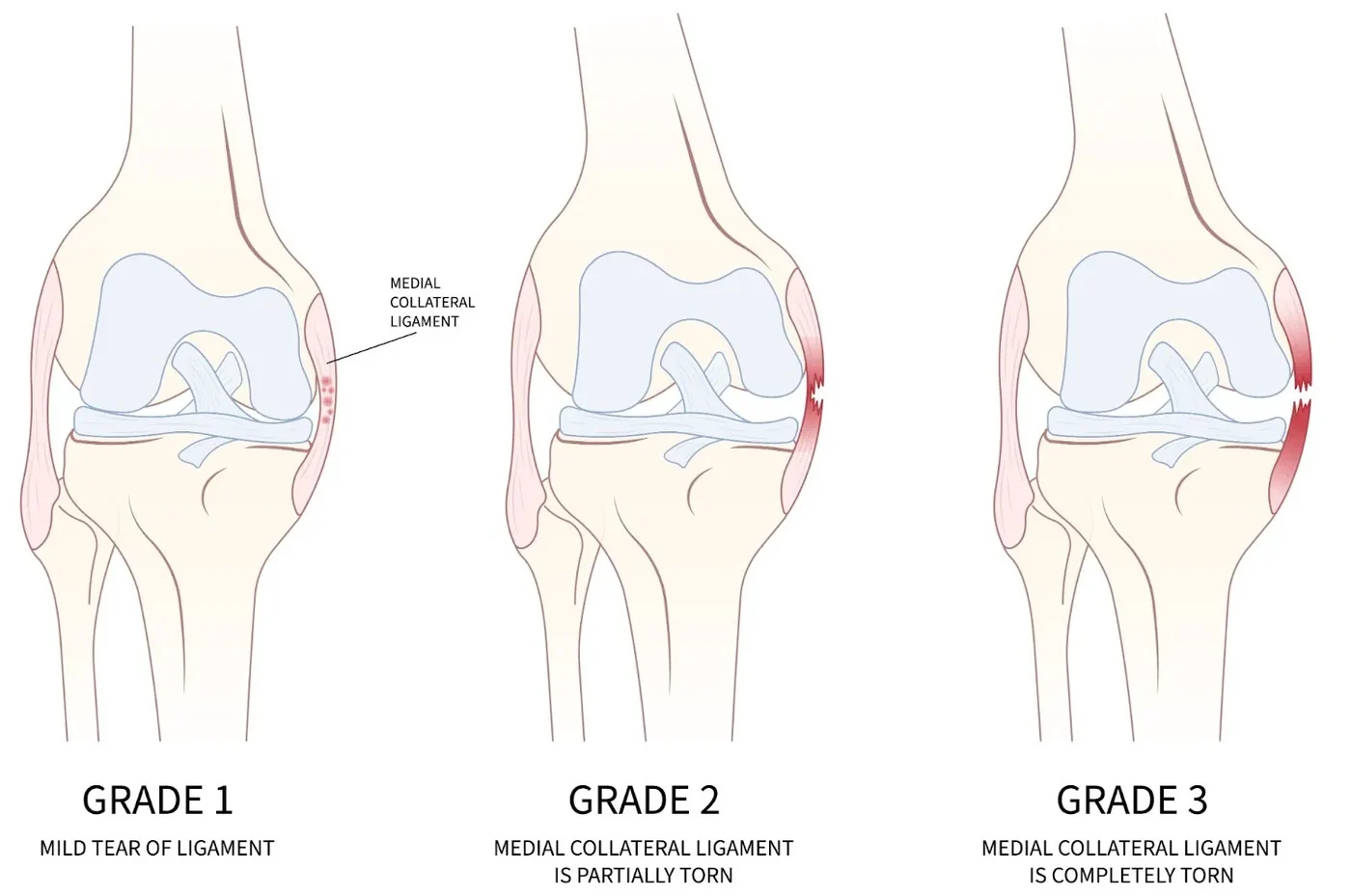
- Return to sport is typically about one to two weeks after a grade 1 injury, three to six weeks after a grade 2 injury and six to eight weeks after a grade 3 injury
- These are typical ranges. When you return depends on your motion, your strength and your ability to protect the knee during sport.
After surgery:
- A brace is worn and only light weight is placed on the leg typically for the first 6 weeks or so
- Bending is increased in steps as you progress
- Running usually starts around 3 months
- Return to sport is around 6 to 9 months after surgery once you meet strength and testing goals
Risks to Understand
- Some lasting residual looseness may be noted after a grade 3 tear but it is usually not noticeable in daily life or sport
- Stiffness can occur especially after surgery. Moving the knee early as directed helps prevent this.
- Re-injury is uncommon
- Any significant knee injury can raise the long-term risk of arthritis
A hinged knee brace may help lower the chance of an MCL injury in some contact athletes such as football linemen. Ask us whether a preventive brace makes sense for your position.
Selected Background Sources
The guidance in this handout reflects current peer-reviewed orthopedic literature and professional society recommendations. Selected sources include:
- American Academy of Orthopaedic Surgeons. Collateral Ligament Injuries. OrthoInfo.
- Wijdicks CA, et al. Injuries to the medial collateral ligament and associated medial structures of the knee. J Bone Joint Surg Am. 2010.
- Encinas-Ullan CA, Rodriguez-Merchan EC. Isolated medial collateral ligament tears: an update on management. EFORT Open Rev. 2018.
- Roach CJ, et al. The epidemiology of medial collateral ligament sprains in young athletes. Am J Sports Med. 2014.
- Lundblad M, et al. The UEFA injury study: 11-year data concerning 346 MCL injuries and time to return to play. Br J Sports Med. 2013.
- Hunter DJ, et al. Randomized clinical feasibility trial: comparing a restrictive and protective range-of-motion brace for the nonsurgical management of the medial collateral ligament of the knee. Clin J Sport Med. 2025.
- Sitler M, et al. The efficacy of a prophylactic knee brace to reduce knee injuries in football: a prospective, randomized study at West Point. Am J Sports Med. 1990.
This handout is for education and does not replace the discussion with your surgeon. Ask Dr. Tummala about anything that applies to your specific knee.
Handouts for this condition
- Condition guideThe printable version of this pageOpen PDF
If you are having surgery
You will receive a guide to your specific operation at your visit. Read what to expect from ACL Reconstruction and MCL Reconstruction, including the instructions and therapy protocols for after surgery. The Preparing for Surgery Booklet is on the Having surgery page.