What Is Anterior Knee Pain?
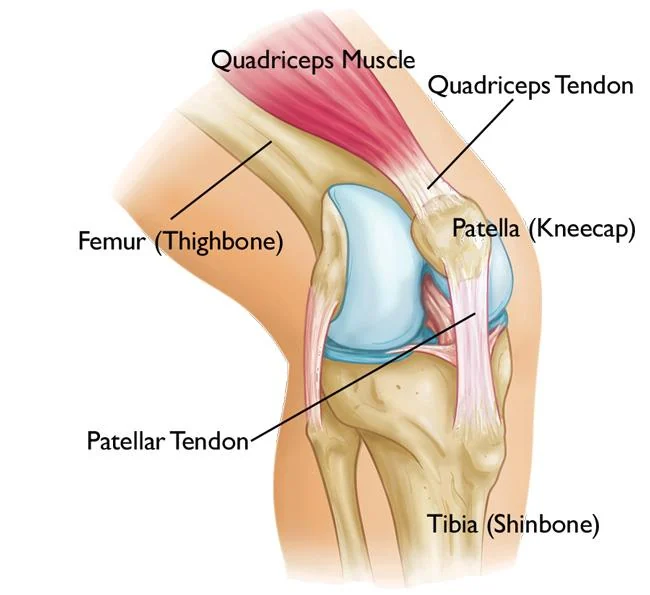
Anterior knee pain, also called patellofemoral pain, is pain felt around or behind the kneecap. It is one of the most common reasons people see a doctor for knee problems, particularly runners and younger active patients and is sometimes called runner’s knee.
The kneecap glides in a groove at the end of the thighbone every time you bend and straighten the knee. Anterior knee pain generally develops when the load passing through that joint exceeds what the surrounding tissues can comfortably tolerate. In most cases there is no obvious structural damage to find, but rather weakness and anatomic variability. The problem is often one of load and mechanics rather than a single torn or broken structure. This is why treatment usually focuses on changing how the knee is loaded and how well the muscles around it control that load with strengthening and flexibility exercises.
Why It Develops
Anterior knee pain is rarely caused by a single factor. It usually reflects a combination of elements that together increase the load on the front of the knee or reduce the body’s ability to control the kneecap (patella). A sudden increase in running volume, a change in training surface or footwear or a return to activity after time off are common triggers.
Weakness of the muscles around the hip is one of the most consistently identified contributors, because the hip controls the position of the thighbone underneath the kneecap. Quadriceps weakness, limited flexibility, and the way you land and squat also play a role. It is more common in women than in men and in adolescents and young adults.
Common Symptoms
- A diffuse ache around or behind the kneecap that is often hard to point to precisely
- Pain going up or down stairs, squatting, kneeling, or running
- Pain after sitting for a long time with the knee bent, sometimes called the theater sign
- A sense of grinding behind the kneecap with movement
- Occasional mild swelling, though large amounts of knee swelling are unusual
- Symptoms that build gradually rather than starting with a single injury
- Paradoxically, pain may also be felt in the back of the knee as referred pain
How It Is Diagnosed
- This is primarily a clinical diagnosis based on your history and examination.
- Examination to assess where the pain is, hip and quadriceps strength, flexibility and how you squat, step down and move.
- X-rays may be obtained to rule out other causes.
- MRI is often not necessary. It is used when the diagnosis is unclear or another problem is suspected.
- Normal imaging does not mean the pain is not real. It means the problem may be one of load and mechanics which are not always captured in static imaging.
Common Contributing Factors
Reduced strength in the muscles that control the hip and pelvis.
The hip controls the position of the thighbone (femur) under the kneecap (patella) during activity
Reduced strength or delayed activation of the thigh muscles.
The quadriceps helps absorb load that would otherwise pass through the knee
A recent increase in volume, intensity, hills, or a change in surface or footwear.
The most common trigger and often the easiest factor to modify
The knee falling inward when you squat, land, or run.
Increases the load on the outer part of the patella
Tightness in the quadriceps, hamstrings, calves, or hip.
Alters how the patella tracks and how load is distributed
Does this mean my knee cartilage is wearing out?
Patients with anterior knee pain often worry that the joint is wearing out or that they are doing damage every time it hurts. In the majority of cases that is not necessarily what is happening. Anterior knee pain is not the same as arthritis and having it does not necessarily mean you are on a path toward needing a knee replacement. Grinding or grating behind the kneecap is also extremely common and does not by itself indicate damage. Many people without any knee pain have the same sensation.
What matters most is that anterior knee pain is almost always treated nonoperatively. That means a dedicated physical therapy and strengthening program, controlling inflammation and modifying the activities that are aggravating the knee. When these are carried out together and given enough time to work, most patients improve significantly. Surgery is rarely the answer for this problem.
Your Treatment Options
Anterior knee pain is treated without surgery in nearly all cases. The most effective treatment is a structured exercise program combined with thoughtful adjustments to training load.
Nonoperative Treatment
The foundation is a targeted exercise program addressing both the hip and the quadriceps. This is more effective than working on the knee alone. Alongside this, adjusting training load reduces the aggravating stress while strength improves. Physical therapy is helpful for learning proper technique and progressing the program. Taping, bracing, or foot orthoses may help symptoms in some patients, and anti-inflammatory medication or acetaminophen can be used for pain if tolerated.
May be appropriate if:
- This is the appropriate treatment for nearly all patients
- Your examination and imaging do not suggest another cause
- You are able to commit to a structured exercise program
Strengthening the hip is often the part patients are most surprised by. Research consistently shows that programs including hip strengthening outperform those focused on the knee alone.
Operative Treatment
Surgery has a small role in the treatment of anterior knee pain itself. If symptoms are not improving with a well-executed program, the more useful question is usually whether something else is contributing or whether the approach needs to be altered.
Other conditions that can cause pain at the front of the knee include patellar or quadriceps tendonitis, cartilage injury behind the kneecap, patellar instability, an irritated plica and irritation of the fat pad beneath the kneecap.
Surgery is only considered when a specific structural problem is identified that is unlikely or has failed to respond to rehabilitation alone.
Consider further evaluation if:
- Symptoms are not improving after a genuine trial of a structured program
- The knee catches, locks or gives way
- There is significant or recurrent swelling
- The pain began with a specific injury rather than gradually
What to Expect
What Recovery Looks Like
- Most patients notice meaningful improvement within six to twelve weeks of consistent therapy and continue to improve beyond that.
- Progress is rarely linear. Good weeks and flares are both normal and a flare does not mean you have undone your progress.
- You can usually keep training in modified form rather than stopping entirely.
- Strength gains often lag behind symptom relief. Continuing the program after you feel better is important to prevent recurrence as much as possible.
- Your consistency with the exercise program is the single most important factor you control!
Risks to Understand
- Anterior knee pain can be persistent, and some patients have symptoms that come and go over years.
- Returning to full training volume too quickly is the most common reason symptoms recur.
- Rest alone tends to help temporarily, but then the pain often returns when activity resumes if not accompanied by the appropriate therapy program.
- Surgery has a very small role in treating anterior knee pain itself and is not part of routine treatment.
Selected Background Sources
Reflects current peer-reviewed literature and professional society recommendations:
- Willy RW, et al. Patellofemoral Pain: Clinical Practice Guideline. J Orthop Sports Phys Ther. 2019.
- Collins NJ, et al. 2018 Consensus statement on exercise therapy and physical interventions for patellofemoral pain. Br J Sports Med. 2018.
- Bolgla LA, et al. National Athletic Trainers’ Association Position Statement: Management of Individuals With Patellofemoral Pain. J Athl Train. 2018.
- Crossley KM, et al. 2016 Patellofemoral pain consensus statement: recommended physical interventions. Br J Sports Med. 2016.
- van der Heijden RA, et al. Exercise for treating patellofemoral pain syndrome. Cochrane Database Syst Rev. 2015.
- Lack S, et al. Proximal muscle rehabilitation is effective for patellofemoral pain: systematic review with meta-analysis. Br J Sports Med. 2015.
- Rathleff MS, et al. Is hip strength a risk factor for patellofemoral pain? Systematic review and meta-analysis. Br J Sports Med. 2014.
- Barton CJ, et al. The ‘Best Practice Guide to Conservative Management of Patellofemoral Pain’. Br J Sports Med. 2015.
This handout is for education and does not replace the discussion with your surgeon.
Handouts for this condition
- Condition guideThe printable version of this pageOpen PDF
- Home exercise programExercises with pictures and a progress logOpen PDF
- Physical therapy protocolNonoperative plan to bring to your therapistOpen PDF