What Is an Ankle Sprain?
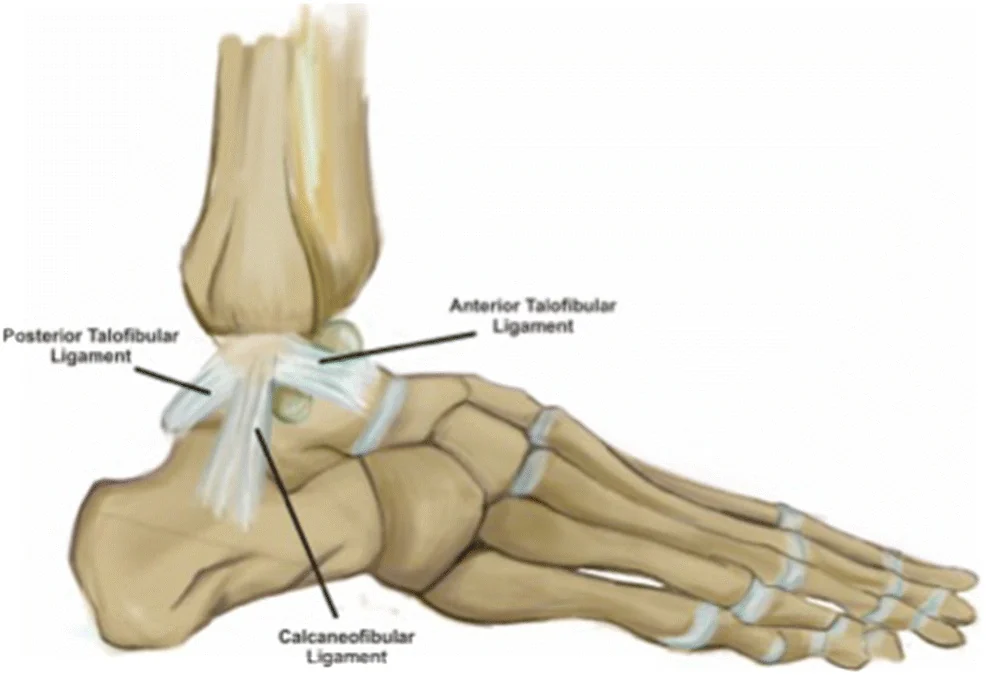
An ankle sprain is a stretch or tear of the ligaments that hold the ankle bones together. Most sprains involve the ligaments on the outside of the ankle. They are one of the most common injuries in sport and in everyday life.
Three ligaments support the outside of the ankle. The anterior talofibular ligament (ATFL) is the weakest and is usually the first one injured. The calcaneofibular ligament (CFL) is often injured along with it in more significant sprains. The posterior talofibular ligament is the strongest of the three and is rarely injured except in severe sprains.
How Ankle Sprains Happen
The classic mechanism is rolling the ankle inward with the foot pointed down. This often happens when landing on another player's foot, cutting/pivoting, or stepping on uneven ground. Sports with running, jumping and quick changes of direction such as basketball, volleyball and soccer carry the highest risk.
The strongest risk factor for a sprain is having had one before. An ankle that has been sprained is more likely to be sprained again, especially if strength and balance have not fully recovered. This is why rehabilitation matters even after a mild sprain.
Common Symptoms
- Pain and tenderness on the outside of the ankle
- Swelling and bruising, which can spread down into the foot over the first few days
- Difficulty putting weight on the foot in more severe sprains
- Some people feel or hear a pop at the time of injury
- Stiffness and a feeling that the ankle is weak or unstable
How It Is Diagnosed
- A history of how the injury happened and a physical examination
- An X-ray may be performed to rule out other associated injuries.
- MRI is usually only needed if the ankle is not healing as expected
Grades of Ankle Sprain
When a Sprain Is Not Just a Sprain
Some injuries can look like a simple sprain at first, including small fractures, cartilage injuries inside the joint and injuries to the tendons on the outside of the ankle. A high ankle sprain can also be hard to recognize early.
Let us know if the ankle is not improving as expected or if you feel catching or locking in the joint.
Your Treatment Options
Almost all ankle sprains heal without surgery. The best evidence supports early movement and a guided exercise program rather than long periods in a cast or boot.
Nonoperative Treatment
Early movement and weight bearing as tolerated lead to a faster recovery than resting the ankle in a cast. A brace gives better support than an elastic wrap. A more rigid brace is often used for the first several weeks, followed by a lace-up brace when you return to sport.
For severe sprains, a short period in a walking boot of up to about 10 days can settle pain and swelling before rehabilitation begins. Ice, elevation and a short course of acetaminophen or an anti-inflammatory medication can help with pain.
Rehabilitation is the most important part of recovery. The goal of an ankle sprain rehabilitation program is to restore motion, strength and balance. Balance training in particular is important to help lower the chance of another sprain.
The right first step for:
- Nearly all first-time sprains, whether mild, moderate or severe
Start the rehabilitation program promptly and finish it even after the ankle feels better. This helps the muscles around the ankle regain strength and develop proprioceptive ability to help prevent future injuries.
Surgical Treatment
Surgery is considered for select cases of chronic ankle instability. This refers to an ankle that keeps giving way or limits activity despite a proper course of bracing and rehabilitation. We generally want to see three to six months of consistent rehabilitation prior to considering surgery.
The most common operation is a modified Broström repair, which tightens and reattaches the stretched ligaments on the outside of the ankle. It has a long track record of good results.
Often recommended if:
- The ankle keeps giving way after three to six months of consistent rehabilitation and bracing
- Repeated sprains are limiting your sport, work or daily activity
- A related injury such as a cartilage injury or tendon tear also needs treatment
Recovery and Return to Sport
Recovery and Return to Activity
Without surgery:
- Most people are walking comfortably in a brace within days to a couple of weeks, depending on the severity
- Return to sport is typically about one to two weeks after a mild sprain, two to six weeks after a moderate sprain and six to twelve weeks after a severe sprain
- A high ankle sprain usually takes longer, often at least six to eight weeks
- Return is based on how the ankle is working not just the time since injury. You should have full motion, normal strength and balance, and be able to hop and change direction without pain.
- Ongoing pain, repeat sprains, stiffness or a feeling that the ankle is unstable can be signs that rehabilitation is not yet complete.
- Consider wearing a brace for sports for up to 12 months after the injury
After surgery:
- Return to sport after a ligament repair usually takes several months, often around five to six months
Risks to Understand
- Repeat sprains are common. This is more likely in the first year or when rehabilitation is cut short.
- There is a small risk of chronic ankle instability, with an ankle that keeps giving way. Effective rehab and recovery help reduce this risk.
- Some people have lingering pain, swelling or weakness for months, even after a mild sprain
- Bracing and balance training are the best ways to lower the chance of another sprain.
Selected Background Sources
The guidance in this handout reflects current peer-reviewed orthopedic literature and professional society recommendations. Selected sources include:
- American Academy of Orthopaedic Surgeons. Sprained Ankle. OrthoInfo.
- Vuurberg G, et al. Diagnosis, treatment and prevention of ankle sprains: update of an evidence-based clinical guideline. Br J Sports Med. 2018.
- Kaminski TW, et al. National Athletic Trainers' Association position statement: conservative management and prevention of ankle sprains in athletes. J Athl Train. 2013.
- Martin RL, et al. Ankle stability and movement coordination impairments: lateral ankle ligament sprains revision 2021. J Orthop Sports Phys Ther. 2021.
- Lamb SE, et al. Mechanical supports for acute, severe ankle sprain: a pragmatic, multicentre, randomised controlled trial. Lancet. 2009.
- Kerkhoffs GM, et al. Functional treatments for acute ruptures of the lateral ankle ligament: a systematic review. Acta Orthop Scand. 2003.
- Hupperets MD, et al. Effect of unsupervised home based proprioceptive training on recurrences of ankle sprain: randomised controlled trial. BMJ. 2009.
- Janssen KW, et al. Bracing superior to neuromuscular training for the prevention of self-reported recurrent ankle sprains: a three-arm randomised controlled trial. Br J Sports Med. 2014.
- Roemer FW, et al. Ligamentous injuries and the risk of associated tissue damage in acute ankle sprains in athletes: a cross-sectional MRI study. Am J Sports Med. 2014.
- Hur ES, et al. Lateral ligament instability: review of pathology and diagnosis. Curr Rev Musculoskelet Med. 2020.
- Aicale R, Maffulli N. Chronic lateral ankle instability: topical review. Foot Ankle Int. 2020.
This handout is for education and does not replace the discussion with your surgeon. Ask Dr. Tummala about anything that applies to your specific ankle.