What Is the Achilles Tendon?
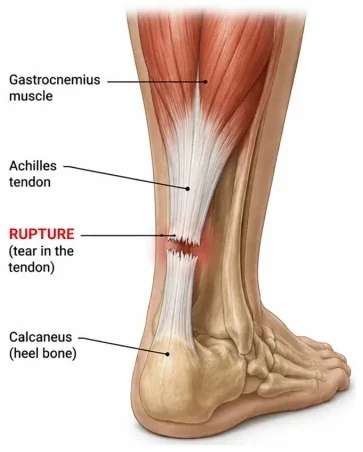
The Achilles tendon is the thick tendon at the back of the ankle. It connects the calf muscles to the heel bone (calcaneus) and lets you push off when you walk, run and jump. It also helps move your ankle down.
A rupture is a tear of the tendon. Most people feel a sudden pop at the back of the ankle, as if they were kicked. Afterward it is hard to push off or stand on your toes.
How Achilles Ruptures Happen
The usual cause is a sudden, forceful push-off. This can happen with sprinting, jumping or a quick change of direction. Less often the foot is forced upward suddenly such as stepping in a hole.
Achilles ruptures are most common in men in their 30s and 40s. Men are affected several times more often than women. Most ruptures happen during sport often basketball or racquet sports.
A tendon usually has some wear (degeneration) before it ruptures even when there were no symptoms. Some people remember pain or stiffness in the tendon beforehand. Steroid pills, steroid injections near the tendon and a type of antibiotic called a fluoroquinolone (such as ciprofloxacin or levofloxacin) can also weaken the tendon.
Common Symptoms
- Sudden pain at the back of the ankle often with a pop
- A feeling of being kicked in the back of the leg
- Trouble pushing off or standing on your toes
- Swelling and bruising around the back of the ankle
- A palpable gap in the tendon above the heel
How It Is Diagnosed
- A history of how the injury happened and a physical examination. We typically check the tendon and gently squeeze the calf to see how the foot moves.
- The diagnosis is usually made from the examination, often without a scan.
- An ultrasound or MRI may be used
- An MRI can sometimes describe a tear as partial when the tendon is functionally torn through.
Surgery Compared With Nonoperative Care
Both surgery and nonoperative care are reasonable options. For most people, function and satisfaction end up similar after about a year. The main trade-off is a lower chance of the tendon tearing again with surgery against the risks of an operation. In one study of over 500 patients, the tendon tore again in about 1 in 100 people after surgery and about 6 in 100 without surgery.
Less likely
More likely
Recovers a bit faster and more fully. Some studies show high level athletes may be more explosive with surgery than nonoperative care.
Recovers a bit more slowly
Possible wound healing problems, infection or numbness on the outer foot
Rare
Similar
Similar
Similar. Return to work may be slightly sooner.
Similar
Starting Treatment Early
Treatment works best when it starts early, ideally within the first week or two from injury. This is true for both surgery and nonoperative care.
Without surgery, the ankle is placed in a boot with the toes pointed down so the torn ends can heal together. Heel wedges are removed over time and the tendon should not be stretched early on.
Your Treatment Options
The right choice depends on your activity level, your health and your goals. We will talk through both options with you.
Nonoperative Treatment
The ankle is placed in a boot with the toes pointed down and heel wedges are removed over several weeks as the tendon heals. Weight bearing in the boot usually starts early and is increased in steps.
Physical therapy restores motion and calf strength over the following months.
May be appropriate if:
- Treatment can start soon after the injury
- You prefer to avoid surgery
- Diabetes, smoking or poor circulation make wound healing a concern
Calf strengthening is the most important part of recovery with either treatment. Keep up the program even after you are walking normally.
Surgical Treatment
Surgery sews the torn ends of the tendon back together. This may be done through one incision or through smaller incisions, depending on the tear.
The incision is watched closely as it heals, because wound problems are the main risk of surgery.
Often recommended if:
- You are a competitive athlete or want the lowest chance of the tendon tearing again
- Treatment could not start early
- The rupture is more than a few weeks old. These older tears may need a more involved reconstruction.
Recovery and Return to Sport
Recovery and Return to Activity
After surgery:
- A splint is worn with no weight on the foot typically for the first few weeks
- A boot with heel wedges follows with weight increased in steps as you progress
- Desk work is often possible within 1 to 2 weeks
- Running usually starts around 6 months
- Return to sport is around 8 to 9 months after surgery, once you meet strength and testing goals
Without surgery:
- Recovery follows a similar path in a boot with heel wedges
- Return to sport often takes a similar amount of time and is guided by calf strength and function
With either treatment:
- Most people return to sport. Returning to the same level can take a year or longer.
Risks to Understand
- Some lasting calf weakness is common with either treatment. This makes the strengthening program very important.
- The tendon can tear again. This is less likely after surgery.
- Surgery carries a risk of wound problems, infection or numbness along the outer foot
- Blood clots in the leg are more likely after this injury. Let us know right away about new calf swelling, pain or shortness of breath.
- The Achilles on the other side is at higher risk of tearing in the future so it is important to maintain strength on both sides.
Keeping both calves strong, building up activity gradually and being cautious with fluoroquinolone antibiotics and steroid injections may help protect your Achilles tendons.
Selected Background Sources
The guidance in this handout reflects current peer-reviewed orthopedic literature and professional society recommendations. Selected sources include:
- American Academy of Orthopaedic Surgeons. Achilles Tendon Rupture (Tear). OrthoInfo.
- Chiodo CP, et al. Diagnosis and treatment of acute Achilles tendon rupture. J Am Acad Orthop Surg. 2010.
- Myhrvold SB, et al. Nonoperative or surgical treatment of acute Achilles' tendon rupture. N Engl J Med. 2022.
- Ochen Y, et al. Operative treatment versus nonoperative treatment of Achilles tendon ruptures: systematic review and meta-analysis. BMJ. 2019.
- Willits K, et al. Operative versus nonoperative treatment of acute Achilles tendon ruptures: a multicenter randomized trial using accelerated functional rehabilitation. J Bone Joint Surg Am. 2010.
- Nilsson-Helander K, et al. Acute Achilles tendon rupture: a randomized, controlled study comparing surgical and nonsurgical treatments using validated outcome measures. Am J Sports Med. 2010.
- Lantto I, et al. A prospective randomized trial comparing surgical and nonsurgical treatments of acute Achilles tendon ruptures. Am J Sports Med. 2016.
- Costa ML, et al. Plaster cast versus functional bracing for Achilles tendon rupture: the UKSTAR RCT. Health Technol Assess. 2020.
- Lemme NJ, et al. Epidemiology of Achilles tendon ruptures in the United States: athletic and nonathletic injuries from 2012 to 2016. Orthop J Sports Med. 2018.
This handout is for education and does not replace the discussion with your surgeon. Ask Dr. Tummala about anything that applies to your specific ankle.
Handouts for this condition
- Condition guideThe printable version of this pageOpen PDF
If you are having surgery
You will receive a guide to your specific operation at your visit. Read what to expect from Tendon Repair, including the instructions and therapy protocols for after surgery. The Preparing for Surgery Booklet is on the Having surgery page.