What Is a Hamstring Injury?
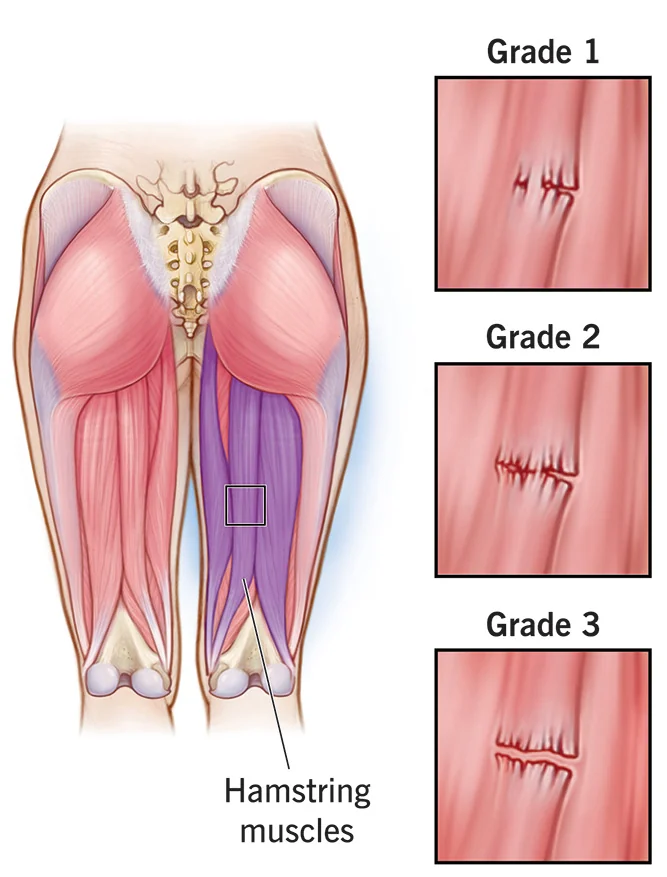
The hamstrings are three muscles on the back of the thigh. They start at the sit bone (ischial tuberosity) and attach just below the knee. They bend the knee and help drive the hip back when you run.
Most injuries are strains where the muscle meets the tendon. Less often the tendons pull off the sit bone. This is a tendon tear (avulsion). In growing athletes the tendon can pull off a piece of bone instead. This is a bony avulsion.
Hamstring injuries are among the most common injuries in sprinting sports. They make up about 1 in 10 sports injuries.
How Hamstring Injuries Happen
Injuries usually happen with the hip bent forward and the knee straight. This stretches the hamstring under load. More severe injuries tend to take longer to heal.
A previous hamstring injury raises the risk about 2 to 3 times. The risk is highest in the first weeks after returning to sport. This is why a prevention program is important to lower the chance of another injury.
Common Symptoms
- A sudden pop or sharp pain in the back of the thigh during activity
- Bruising on the back of the thigh. This often appears about a week after the injury.
- A lump may be felt in the middle of the back of the thigh
- Walking with a stiff leg to avoid bending the hip and knee
How It Is Diagnosed
- A history of how the injury happened and a physical examination
- Pain at the sit bone can mean the tendon has pulled off the bone
- An X-ray may be performed to look for a bony avulsion, especially in teens
- MRI is the best test when a tendon tear is suspected
Let Us Know
Let us know if you have numbness, tingling or weakness in the leg or foot or if you are a teen with pain at the sit bone after sprinting or kicking.
Your Treatment Options
Most hamstring strains heal without surgery. Early, guided rehabilitation is the most important part of recovery.
Nonoperative Treatment
Usually treated without surgery:
- Strains and partial tendon tears
- Single tendon tears
- Two-tendon tears that have not pulled back far
- Tears in less active patients
What to expect:
- For a strain, crutches are used only until you can walk without a limp
- Starting rehabilitation within the first few days leads to a faster return than waiting to feel completely better before starting therapy
- For a tendon tear, protected weight bearing with crutches for about 4 weeks or more may be needed. Initial healing takes up to about 6 weeks.
- Rehabilitation strengthens the hamstring while it lengthens. A running program then builds up to full-speed sprinting.
- PRP (platelet-rich plasma) injections have not always been shown to speed return to sport or prevent reinjury. We may discuss PRP in select cases.
Finish the rehabilitation program even after the leg feels better. Most reinjuries happen in the first weeks after returning to sport.
Surgical Treatment
Surgery reattaches the torn tendons to the sit bone.
Often considered if:
- All three tendons are torn
- Two tendons are torn and have pulled back more than about 2 cm, especially in active patients who want to return to running sports
- A teen's bony avulsion has moved more than about 1.5 to 2 cm
- The injury does not improve with nonoperative care
Repairs done early, within the first few weeks, tend to do better than delayed repairs.
Recovery and Return to Sport
These are typical ranges. When you return depends on your strength, your running and your ability to sprint without pain.
Before Returning to Sport
- Sprint at full speed without pain
- Hamstring strength at least 90% of the other side
- Full motion without pain or tenderness
- Complete full practices for your sport without symptoms
Risks to Understand
- Reinjury is common after a strain. About 1 in 6 athletes reinjure the hamstring within a year.
- Prevention programs and finishing rehabilitation help lower the risk of reinjury.
- Surgery has risks including nerve problems and the tendon tearing again. These risks may be less common when the repair is done early.
- A bony avulsion that has moved more than about 2 cm may not heal to the bone without surgery
Preventing Another Injury
The Nordic hamstring exercise strengthens the hamstring as it lengthens. You kneel while a partner holds your ankles and slowly lower your body forward. Learn it under the direction of a therapist to make sure you are doing it correctly.
Programs that include it may cut hamstring injuries significantly, by up to half.
It works only if you keep doing it. Build up slowly, then continue once or twice a week during the season.
Selected Background Sources
The guidance in this handout reflects current peer-reviewed orthopedic literature and professional society recommendations. Selected sources include:
- American Academy of Orthopaedic Surgeons. Hamstring Muscle Injuries. OrthoInfo.
- Maniar N, et al. Incidence and prevalence of hamstring injuries in field-based team sports: a systematic review and meta-analysis. Br J Sports Med. 2023.
- Green B, et al. Recalibrating the risk of hamstring strain injury (HSI): a 2020 systematic review and meta-analysis of risk factors for index and recurrent hamstring strain injury in sport. Br J Sports Med. 2020.
- Askling CM, et al. Acute hamstring injuries in Swedish elite football: a prospective randomised controlled clinical trial comparing two rehabilitation protocols. Br J Sports Med. 2013.
- Bayer ML, et al. Early versus delayed rehabilitation after acute muscle injury. N Engl J Med. 2017.
- Reurink G, et al. Platelet-rich plasma injections in acute muscle injury. N Engl J Med. 2014.
- Bodendorfer BM, et al. Outcomes after operative and nonoperative treatment of proximal hamstring avulsions: a systematic review and meta-analysis. Am J Sports Med. 2018.
- Hillier-Smith R, Paton B. Outcomes following surgical management of proximal hamstring tendon avulsions: a systematic review and meta-analysis. Bone Jt Open. 2022.
- Zein MI, et al. Baseline clinical and MRI risk factors for hamstring reinjury: a multicentre, prospective cohort of 330 acute hamstring injuries. Br J Sports Med. 2024.
- van Dyk N, et al. Including the Nordic hamstring exercise in injury prevention programmes halves the rate of hamstring injuries. Br J Sports Med. 2019.
This handout is for education and does not replace the discussion with your surgeon. Numbers come from specific studies, may not apply to you and do not guarantee any result. Ask Dr. Tummala about anything that applies to your specific injury.
Care in the East Bay
Dr. Sai Tummala treats hamstring injuries at Stanford Health Care Emeryville, near the east end of the Bay Bridge, for patients from Oakland, Berkeley, San Francisco and across the East Bay. Request an appointment or call 510-974-2800.